In this essay
Adyen receiving a UAE payments license is easy to file under expansion news. The more useful read is operational.
On 28 June 2026, Adyen announced that it had obtained a Retail Payment Services Category II license from the Central Bank of the UAE. The company said the license gives it full control over local settlements without reliance on third parties and strengthens oversight across compliance and settlement processes.
That is the part I would focus on.
For enterprise merchants, acquiring quality is rarely decided by the homepage promise. It is decided by who controls settlement timing, exception handling, reserve logic, compliance evidence, and the speed of shipping local payment capabilities. A license that pulls more of that stack onshore changes the operating model, not just the press release.
Why this matters in the UAE
The UAE is one of the few markets where global platforms, regional champions, and digitally ambitious enterprise merchants all collide in the same payment environment.
Merchants want three things at once:
- strong ecommerce conversion
- reliable point-of-sale and omnichannel flows
- local settlement and support discipline that finance teams can trust
That combination is harder than it looks.
The CBUAE licensing framework treats retail payment services as regulated activities. The control burden sits inside licensing, supervision, settlement, customer-money handling, and operational resilience. In practice, that means a PSP cannot fake local depth for long. If settlement files are slow, if merchant exceptions route through too many intermediaries, or if compliance reviews depend on external parties, the merchant feels it in cash flow and support load.
That is why Adyen's language around local settlement control matters more than generic regional-growth language.
The real upgrade is value-chain ownership
When a processor relies heavily on third parties for the local leg, the merchant may still see one dashboard and one contract, but the operating stack is split underneath:
- one party controls merchant-facing product
- another controls parts of settlement
- another may own local compliance workflows or bank interfaces
That split shows up in the worst places:
- delayed settlement answers
- slower issue resolution
- weaker audit trails
- slower rollout of local payment features
Adyen's announcement suggests the company is reducing exactly that gap inside the UAE.
For a merchant acquirer, owning more of the local value chain usually improves four things.
First, settlement confidence. Finance teams care less about branding than about knowing when money lands, how fees reconcile, and who can explain a break in one call.
Second, compliance speed. If the PSP has tighter local control, the distance between a flagged issue and a decision usually shrinks.
Third, product velocity. Fraud controls, new payment methods, routing logic, and unified-commerce features move faster when fewer third parties sit in the release path.
Fourth, enterprise credibility. Large merchants want to know whether their PSP is truly operating locally or just brokering local access.
That is a bigger commercial differentiator than most product teams admit.
What this does not guarantee
A local license is meaningful. It is not magic.
It does not automatically mean:
- the best authorization rates
- the best local payment-method mix
- the lowest cost to serve
- the strongest support model
- the cleanest onboarding and risk controls
Those still depend on execution.
This is where payment teams often confuse regulatory depth with product strength. They are related, but they are not the same thing. A PSP can be well licensed and still ship poor merchant workflows. It can own settlement and still underperform on approval rate. It can be locally present and still fail to explain reserves, disputes, or reconciliation clearly.
That is the same mistake teams make when they treat authorization rate as a gateway KPI instead of a merchant P&L metric. Owning the rail is useful only if the economics and merchant experience improve with it.
Why this is strategically interesting for acquiring
The most interesting signal here is not that Adyen is entering the UAE. It has had a presence there since 2020. The interesting signal is that it is tightening operational ownership in a market where enterprise merchants increasingly want:
- one platform across online and in-store
- better local settlement control
- cleaner compliance operations
- faster access to newer payment experiences
That fits the direction of acquiring more broadly. Acquirers are no longer selling pure processing. They are selling a managed operating system for acceptance, settlement, risk, reconciliation, and omnichannel commerce.
You can see the same pattern in different form in Visa's Data Only 3DS push, where the real value is not the feature itself but the economics and control structure behind it.
The operator takeaway
If I were evaluating this move as a product or GM leader, I would track five things next:
- Whether Adyen shortens settlement and exception-resolution loops for UAE merchants.
- Whether local control translates into better compliance responsiveness and clearer audit evidence.
- Whether it accelerates rollout of regional payment methods and fraud features.
- Whether merchant support quality improves when local operations own more of the flow.
- Whether enterprise merchants can actually feel the difference in cash visibility and issue turnaround.
That is the real scorecard.
The market narrative will say Adyen got approval in the UAE. The operator narrative is sharper: Adyen is reducing dependency in the local acquiring stack, and that can become a real merchant advantage if execution follows.
The debate point: in the Gulf, does the next winning acquiring layer come from better local licenses, better orchestration, or better merchant economics from the same rails?
FAQ
What did Adyen receive in the UAE?
Adyen said on 28 June 2026 that it received a Retail Payment Services Category II license from the Central Bank of the UAE.
Why is local settlement control important for merchants?
It improves visibility into when funds settle, who resolves exceptions, how compliance issues are handled, and how quickly local payment operations can adapt.
Does a local license guarantee better acquiring performance?
No. It improves control and can improve execution, but merchants still judge on authorization rate, settlement reliability, support quality, onboarding, and total economics.
Closing thought and further reading
Adyen's UAE approval is not just expansion news. It changes who controls settlement, compliance loops, and merchant operating reliability.
Ideas that continue the thread.
View all essays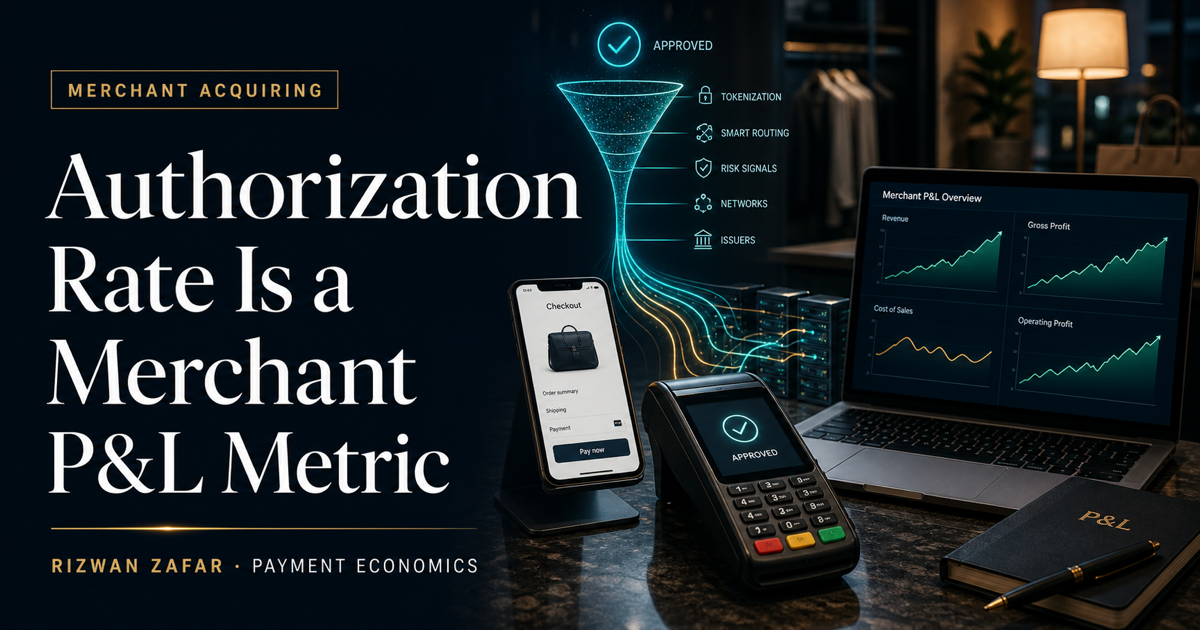
Building through similar complexity?
Discuss the operating decisions behind the essay, or explore where my experience can help.