In this essay
Payments teams have heard enough AI promises.
The useful question is narrower: what changes in the operating loop?
On 13 July 2026, Checkout.com published a detailed explanation of how it thinks about AI-powered payment optimization. The interesting part is not the claim that AI can improve acceptance. The interesting part is the operating model: issuer-level learning, market-specific strategy, measurable experiments, control groups, and the ability to reverse an optimization when it degrades performance.
That is the difference between AI as a label and AI as payment infrastructure.
The Short Answer
AI payment optimization works only when it is run as a controlled learning system. The model should improve authentication choices, token decisions, message formatting, routing, and retries, but every change needs a goal, control group, degradation trigger, reversibility path, and risk guardrail. In payments, an AI lift that cannot be explained or rolled back is an operational liability.
Authorization rate is not a vanity metric. It is merchant revenue, customer experience, fraud exposure, scheme cost, and support load in one number.
Acceptance Is Local, Not Average
Checkout.com's point about global diversity matters. It says payment performance is shaped by different issuers, markets, schemes, merchant types, regulations, and transaction patterns. The same strategy can help in one market and hurt in another.
That is the reality operators see every day.
An SCA exemption that works for one issuer may fail with another. A network token can lift recurring approvals for one merchant category and underperform for another. A retry can recover a soft decline or annoy the issuer into a harder one. A route can reduce cost but lower approval. A message-field change can look trivial until it changes how a bank scores the transaction.
This is why authorization rate is a merchant P&L metric, not a gateway dashboard decoration.
AI is useful when it learns those local patterns faster than static rules. It is dangerous when it hides them inside one global average.
The Control Group Is The Product
The strongest detail in Checkout.com's public documentation is its impact-assessment model. Checkout.com's docs explain that a small percentage of transactions are intentionally left unoptimized as a control group, and that Checkout.com compares optimized transactions against that group before claiming an acceptance-rate boost.
That is the right bar.
Payment optimization is not one big switch. It is a portfolio of micro-decisions:
- should this transaction request 3DS?
- which SCA exemption should be attempted?
- should the platform send a network token or original credential?
- should a transaction route through a local or global path?
- should a retry happen, and when?
- which message fields need adjustment for this issuer pattern?
- when should fraud protection override conversion?
Each decision can improve or damage performance. Each should have a hypothesis, eligible population, baseline, control group, measurement window, and rollback condition.
That is product discipline, not data-science theatre.
Guardrails Matter More Than Autonomy
Checkout.com's Intelligent Acceptance page describes optimization across message formatting, authentication, token choice, routing, and retries. It also says merchants can define goals so optimizations drive conversion without unnecessary risk.
That goal-setting layer is critical.
Not every merchant wants the same optimization. A gaming merchant, travel platform, subscription business, marketplace, and regulated fintech may have different tolerance for fraud, friction, chargebacks, cost, latency, and issuer scrutiny.
A serious AI optimization product should expose trade-offs:
- approval rate versus fraud loss;
- cost versus authorization uplift;
- frictionless flow versus liability shift;
- retry recovery versus issuer fatigue;
- token adoption versus wallet or credential coverage;
- local routing versus reconciliation complexity.
If the system only says "AI will maximize acceptance," the operator should be skeptical. Maximize under which constraints?
Payments AI Is Mostly Decision Infrastructure
This is where payments differs from many consumer AI use cases.
The model is not writing a paragraph. It is changing a transaction path. That path affects authorization, authentication, settlement, disputes, fraud operations, reconciliation, customer messaging, and merchant economics.
The evidence model has to be stronger.
For every material optimization, a platform should log:
- model or policy version;
- transaction cohort and eligibility rule;
- optimization selected;
- reason code or feature explanation at the right level;
- control or treatment assignment;
- expected effect;
- actual authorization, fraud, dispute, and cost outcome;
- rollback trigger and decision owner.
That record is what lets a payment team debug performance when an issuer changes behavior or a regulation changes the optimal route.
It also keeps AI from becoming a black box in the middle of a regulated money movement process.
Where Human Judgment Belongs
Checkout.com's article emphasizes the combination of model capability and payment-success-manager judgment. That is not a weakness. It is the operating model.
Humans should decide the strategy, risk appetite, eligible populations, experiment boundaries, and escalation rules. Models should search the high-dimensional payment space faster than a rules team can.
The right division is simple:
- humans set the commercial and risk objective;
- models find candidate optimizations;
- experiments prove or reject them;
- guardrails stop unacceptable harm;
- operators review exceptions and drift.
This is the same lesson behind where ML beats generic AI in payments. Many payment problems are structured, measurable, and feedback-rich. They reward disciplined machine learning more than broad language-model improvisation.
The Operator Takeaway
AI payment optimization is credible when it looks boring from the outside: experiments, controls, metrics, rollback, and governance.
The impressive part is not saying "our AI learns from every payment." The impressive part is proving which learning changed which transaction decisions, for which merchant cohort, under which constraints, with what financial and risk impact.
The debate for payment leaders is no longer whether AI can improve acceptance. It can. The debate is whether your organization can operate the control loops without losing accountability.
If your payment stack needs better acceptance, routing, authentication, or retry economics, contact Rizwan to design the control model before turning AI loose on live transaction paths.
FAQ
What did Checkout.com publish?
Checkout.com published a July 2026 explanation of how it uses AI and payment expertise to optimize acceptance across issuers, markets, schemes, and merchant contexts.
What is the main operator lesson?
AI payment optimization needs control groups, success criteria, rollback paths, risk guardrails, and merchant-specific goals.
Why is this different from generic AI automation?
Payment optimization changes live transaction decisions, so the system must be measurable, reversible, auditable, and aligned with merchant risk appetite.
Closing thought and further reading
AI payment optimization is not a magic approval-rate lift. It is a controlled learning system for authentication, tokens, routing, retries, and risk.
Ideas that continue the thread.
View all essays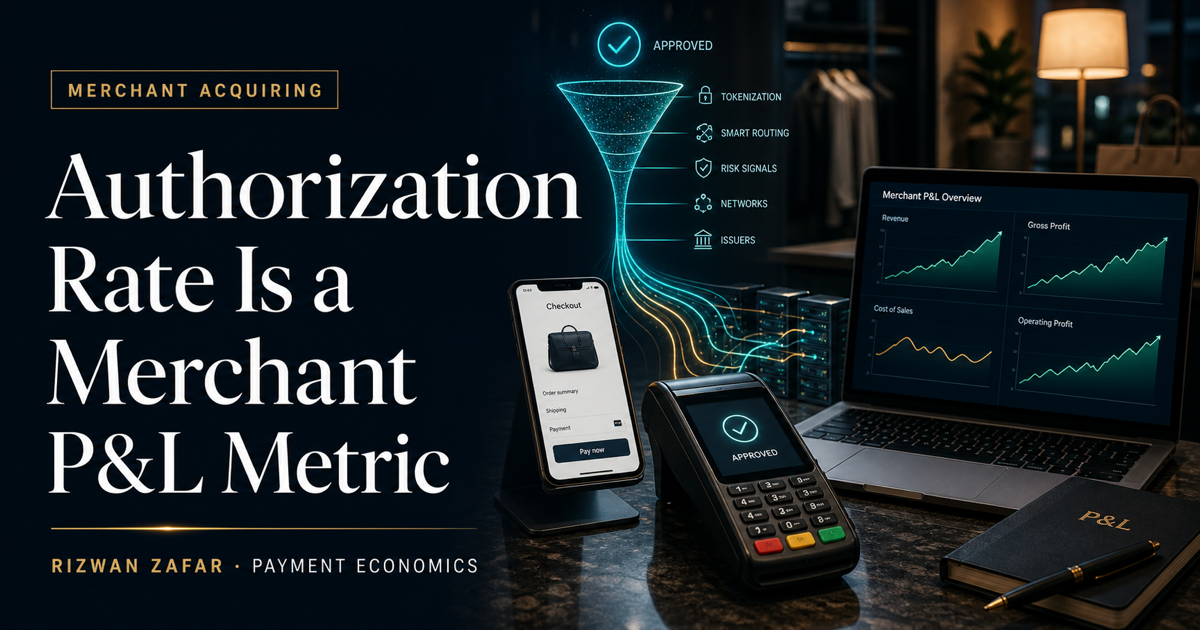

Building through similar complexity?
Discuss the operating decisions behind the essay, or explore where my experience can help.