Saudi Cashless Payments Need an Exception-Control Gate
Saudi retail payments are now mostly electronic. Here is the exception-control gate I would require before scaling more volume across POS, e-commerce and instant payments.
In this essay
Saudi Arabia's payment question has changed.
SAMA announced on 12 April 2026 that electronic payments accounted for 85% of total retail payments in 2025, up from 79% in 2024. The number of electronic transactions reached 14.6 billion, compared with 12.6 billion in 2024.
That is not an adoption story anymore. It is a reliability story.
When most retail payments are electronic, every weak exception process becomes part of national-scale customer experience. A failed POS payment, delayed e-commerce status, mistaken beneficiary, instant-transfer ambiguity, refund mismatch or reconciliation break is no longer edge-case noise. It is the normal operating surface.
The product decision is not whether Saudi payments should become more digital. The decision is what gets slowed, stopped or rerouted when the payment state and the business state disagree.
The Short Answer
For Gulf banks, PSPs, acquirers and merchant operators, Saudi's 85% electronic-payment share should trigger an exception-control gate: before adding more volume, prove that failed, pending, duplicate, reversed and misdirected payments have named owners, time limits, customer messages and reconciliation evidence.
If that gate is missing, higher digital share only moves operational risk from cash desks into product, support, finance and fraud queues.
What The SAMA Numbers Really Mean
The SAMA release is specific enough to change the operating conversation.
Electronic retail-payment share rose from 79% in 2024 to 85% in 2025. Transaction count rose from 12.6 billion to 14.6 billion. SAMA also linked the growth to mada activity, especially POS and e-commerce payments, plus growth across other national payment systems.
Those numbers matter because Saudi payment operations are no longer a digital overlay on top of cash habits. They are the main road.
For a product leader, that changes three questions.
First, is the payment state visible to the customer, merchant, support team and finance team without asking engineering to read logs?
Second, does every ambiguous state have an owner before it becomes a complaint?
Third, can the business prove the money path later, not just tell a customer that the transaction was "processing" at the time?
Sarie Makes The Exception Model More Important
Sarie adds another reason to tighten the operating model.
SAMA's Sarie page describes the system as a national payment system launched in 2021 for low-value transfers of SAR 20,000 or less among local banks. It says transfers are processed instantly, 24/7, throughout the year.
The same page says customers can use alternative identifiers such as mobile number, national ID, residence permit, email address or commercial-establishment unified number. It also says direct transfers of SAR 2,500 or less can be made without adding or activating the beneficiary.
That convenience is valuable. It also raises the quality bar.
Alias-based transfers, instant processing and always-on availability reduce customer friction, but they leave less room for human repair after the fact. The product has to make the right check before the money moves, and it has to keep usable evidence after the money moves.
SAMA's rulebook page on account verification makes the control direction explicit. It instructs banks and financial institutions to implement account verification before completing the addition and activation of beneficiaries for transfers executed through IPS and RTGS, and to provide the service according to Sarie rules and updates.
In plain operating language: growth is welcome, but unchecked speed is not the goal.
The Exception Gate I Would Require
I would not approve a Saudi payments scale-up only because conversion, approval rate or digital share improved.
I would require five exception gates.
Gate 1: State Integrity
The platform should separate payment initiation, customer authentication, issuer or bank acceptance, merchant order release, settlement posting, refund initiation, refund completion and reconciliation.
If the product has one generic "pending" state, it is not ready for scale.
The customer needs a clear message. The merchant needs a fulfillment decision. Finance needs a settlement expectation. Operations needs an owner and a timer.
Gate 2: Beneficiary And Alias Risk
Alias convenience needs an alias-risk register.
For mobile, national ID, residence permit, email or unified-number routing, the product should record what was displayed to the sender, what verification result came back, which identifier type was used, and what action was taken when the name or account signal did not match expectation.
The hard decision is when to slow the user down.
For low-value transfers, speed may be the right default. For new beneficiaries, abnormal amounts, vulnerable-customer patterns or unusual device behavior, the product should require stronger confirmation even if the rail allows speed.
Gate 3: Merchant Order Control
Saudi e-commerce and POS growth means many payment exceptions land inside merchant operations, not only bank operations.
An e-commerce checkout should know whether a payment is initiated, authorized or accepted by the bank, confirmed to the merchant, shipped, refunded or reversed. A store flow needs a terminal and receipt state that can be matched later to acquiring, scheme, bank and ledger evidence.
The dangerous failure is a customer-funded order that the merchant did not release, or a released order that finance cannot reconcile.
Gate 4: Time-Boxed Ownership
Every exception class needs an age limit and owner.
Unknown instant transfer after 60 seconds. POS reversal not seen after end-of-day file. E-commerce order paid but not released. Refund initiated but not credited. Duplicate debit claim. Beneficiary mismatch. Account-verification failure.
The runbook should say who owns each case, what data they inspect, what customer message is allowed, when it escalates, and when product or risk can pause the flow.
Gate 5: Reconciliation Proof
At 14.6 billion electronic transactions, reconciliation cannot be a manual afterthought.
A strong Saudi payment stack should join the customer action, payment rail event, merchant order, ledger entry, settlement file, refund record and support case. Breaks should carry reason codes. Repeated reason codes should become product defects, not just operations reports.
This is where the operator work becomes visible. Growth teams want faster acceptance. Risk teams want fewer wrong payments. Finance wants provable money movement. Support wants a truthful answer. The exception gate forces those teams into one control model.
What I Would Measure
The board metric should not be "electronic share" alone.
For a bank, PSP, acquirer or large merchant, I would measure:
- payment unknown rate after the expected confirmation window;
- duplicate, reversal and refund break rate;
- beneficiary or alias mismatch rate by identifier type;
- customer-contact rate per exception class;
- time to owner assignment and time to resolution;
- value at risk in unreconciled or ambiguous states.
Those are not vanity metrics. They tell the operator whether digital volume is becoming more reliable or simply more hidden.
The Operator Decision
Saudi's cashless progress is real. SAMA's 85% figure and 14.6 billion transactions show a market where digital payments are already mainstream.
The next advantage will not come from another generic "go cashless" message.
It will come from the institutions that make digital payments easier to trust when they fail.
The question I would ask a Saudi payment team before approving more volume is simple:
Which exception would stop us today, and who has the authority to stop, reverse, message or reconcile it?
If the answer is clear, digital growth is an asset.
If the answer is unclear, the platform is scaling an operations queue.
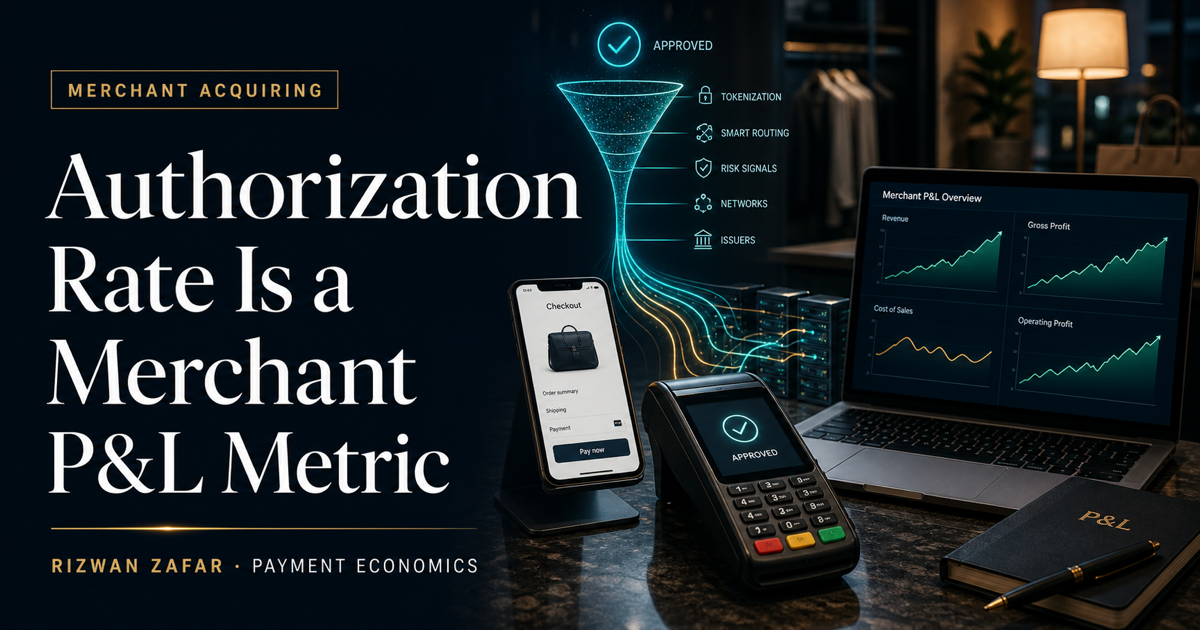
For related operating patterns, read the MENA and South Asia payment infrastructure map, authorization rate as merchant P&L and three-way reconciliation at scale. If your bank, PSP or merchant payment platform needs a sharper launch or exception-control gate, start at /hire/.
FAQ
Why is 85% electronic-payment share an operating signal?
Because electronic payments are now the dominant retail-payment surface in Saudi Arabia. When digital is the default, weak exception handling affects mainstream customer and merchant experience, not only a small digital subset.
Should Saudi payment teams prioritize conversion or exception control?
Both, but in sequence. Conversion improvement should not scale a flow until failed, pending, duplicate, reversed, misdirected and unreconciled payments have clear owners, customer messages and evidence paths.
Sources
Closing thought and further reading
Saudi retail payments are now mostly electronic. Here is the exception-control gate I would require before scaling more volume across POS, e-commerce and instant payments.
Ideas that continue the thread.
View all essays
Building through similar complexity?
Discuss the operating decisions behind the essay, or explore where my experience can help.