In this essay
Every merchant says acceptance rate matters.
The harder question is whether the team can explain the number.
On 16 July 2026, Checkout.com published a payment acceptance-rate guide that defines acceptance rate as successful authorized payments divided by attempted payments. It also points out a detail operators should not skip: definitions vary depending on whether fraud-screened payments, repeated customer attempts, or de-duplicated "net acceptance" are included.
That is where the operating work starts.
The Short Answer
Acceptance rate is not just a checkout KPI. It is an operating model across merchant data quality, acquirer processing, issuer response handling, authentication, fraud policy, routing, retries, tokenization, and support. If the metric is not governed, teams optimize a number they cannot trust.
This matters because the next wave of acquiring competition is not only price. It is explainability.
Clean Up The Numerator First
The worst acceptance-rate dashboard is the one everyone believes for different reasons.
One team includes retries. Another excludes retries. Fraud blocks may sit outside the denominator. Merchant-initiated transactions may be mixed with customer-initiated checkout. Some regions use local acquiring and others route cross-border. 3D Secure step-ups may be counted as failed payments even when the customer abandoned authentication.
That produces a familiar meeting problem: the metric moves, but nobody can say what moved it.
The first operator task is definition control:
- gross acceptance rate: all successful authorizations divided by all authorization attempts;
- net acceptance rate: de-duplicated customer purchase attempts, after retries and alternate payment methods;
- recoverable decline rate: declines that could be addressed through data quality, retry timing, token choice, local acquiring, or authentication tuning;
- protected decline rate: declines the business wants because fraud, compliance, or policy risk is real;
- customer-visible failure rate: the payment moments the buyer experiences as a failed checkout.
These are not academic distinctions. They decide which team owns the next action.
If the false decline is caused by missing or low-quality transaction data, product and integration teams own it. If the issuer response suggests insufficient funds, retry timing or alternate payment method design matters. If the failure is an acquirer or processor outage, resilience and routing matter. If the decline is a fraud-policy false positive, risk owns the trade-off.
One blended metric hides all of that.
Acquirer Processing Is Back In The Room
Checkout optimization used to be discussed mostly at the merchant and PSP layer. That is too narrow now.
Visa launched Visa Intelligent Authorisation in Europe on 19 March 2026 as part of the Visa Acceptance Platform. Visa describes it as a single-API capability for acquirers, with initial partners including Comercia Global Payments, Elavon, Fiserv, UNICRE, and Worldline. The product is positioned around modern authorization, routing decisions, resilience, risk alerts, analytics, oversight, settlement, and regulatory compliance.
The operator signal is clear: acquirers are being asked to act less like pass-through processors and more like performance infrastructure.
That changes the acceptance-rate conversation. A merchant can improve data capture, payment method choice, and retry experience, but the acquirer stack still affects routing, availability, network handling, issuer reach, and visibility. The best acquiring proposition will give merchants both performance and evidence.
That evidence should answer:
- which declines are issuer policy, merchant data, authentication, technical, or fraud-policy related;
- where local acquiring changes the issuer response pattern;
- which retries recover revenue and which simply inflate denominator noise;
- whether tokenized credentials outperform raw card credentials by issuer and region;
- whether 3DS challenge policies are reducing fraud without killing good transactions.
If the acquirer cannot provide that picture, the merchant is managing acceptance through guesswork.
Tokenization And Retries Need Guardrails
The easiest acceptance-rate story is "add tokens and retry more."
The serious version is more constrained.
Checkout.com's 2026 payments trends discuss acceptance-rate gains from tokenized transactions and describe the value of switching between network tokens and raw card numbers based on performance signals. That direction is useful, but it also raises a governance question: who decides when to use which credential, and how is the result measured?
A retry can be customer-friendly or abusive. A token fallback can improve authorization or complicate disputes. A local-acquiring route can lift approvals or create reconciliation and pricing complexity. A fraud rule can protect margin or block good customers.
The control loop should be explicit:
- classify the decline;
- decide whether it is recoverable;
- select the next action: retry, alternate payment method, token choice, authentication, support, or stop;
- measure recovered revenue, incremental fraud, customer complaints, and operational cost;
- retire actions that only make the dashboard look better.
The goal is not a higher acceptance rate at any cost. The goal is profitable, explainable acceptance.
The Scorecard I Would Use
If I owned this as a CPO or acquiring lead, I would not run the business from one acceptance number.
I would run a weekly acceptance operating scorecard:
- gross and net acceptance by country, issuer, BIN range, payment method, channel, and merchant segment;
- false-decline estimates separated from protected risk declines;
- retry recovery rate by decline code and retry timing;
- tokenized versus non-tokenized approval rate, fraud rate, and dispute rate;
- 3DS frictionless, challenge, abandonment, and post-auth fraud outcomes;
- acquirer and processor availability by route;
- reconciliation exceptions created by recovery actions;
- support tickets per 10,000 failed checkout attempts.
That scorecard forces the right trade-off. It also stops executives from asking for a universal "two point acceptance lift" without asking what risk, cost, or customer experience will be exchanged for it.
Operator Takeaway
Acceptance rate is one of the few payments metrics that directly links product, engineering, risk, acquiring, and revenue.
That is exactly why it needs governance.
The debate point: when your acceptance rate moves next week, will your team know whether the business got better, or only that a dashboard changed?
Talk to me about merchant acquiring and checkout performance or review related work on authorization-rate economics, 3DS data-only acquiring, and payment infrastructure execution.
Closing thought and further reading
Acceptance rate only creates value when a merchant can explain the numerator, the denominator, the retry policy, and the owner of each decline state.
Ideas that continue the thread.
View all essays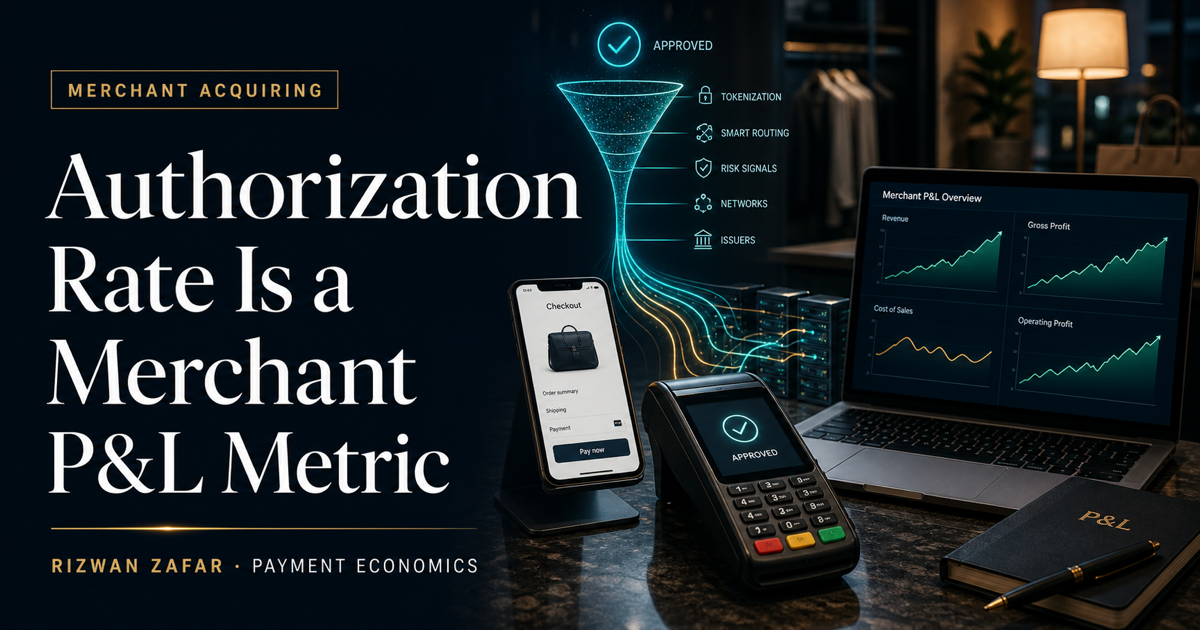

Building through similar complexity?
Discuss the operating decisions behind the essay, or explore where my experience can help.