In this essay
The least useful AI question is "which model is best?"
The better question is "which system makes this agent reliable for this job?"
On 8 July 2026, NVIDIA said LangChain had tuned its Deep Agents harness for NVIDIA Nemotron 3 Ultra, with gains coming from the environment around the model rather than retraining the model itself. LangChain's announcement frames the NemoClaw blueprint as a stack: an open model layer, a tuned agent harness, and a governed runtime.
That is the important signal for fintech and product leaders.
The Short Answer
Production agent performance is a harness problem as much as a model problem. Teams need to tune tools, context, memory, evaluations, runtime policy, cost, and human approval paths before assuming a model swap will fix quality.
This is where most AI pilots become operating systems or die as demos.
The Model Is Only One Layer
A model answers prompts.
An agent system does more. It plans, calls tools, writes files, reads context, delegates to sub-agents, remembers state, summarizes long work, asks for approval, and runs inside a runtime with permissions.
The LangChain Deep Agents GitHub repository describes an open-source agent harness with planning, tool use, memory, context management, filesystem access, human-in-the-loop controls, skills, and bring-your-own tools. Those features are not decorations. They define the operating surface.
For a fintech, the harness decides whether an agent can:
- inspect a payout exception;
- retrieve a merchant file;
- draft a suspicious-activity note;
- summarize a dispute packet;
- query a ledger;
- call a ticketing API;
- escalate to a human before a risky action.
If the harness is loose, the model's intelligence can create more operational risk, not less.
Why The NVIDIA/LangChain Signal Matters
NVIDIA says no model retraining was required for the reported improvement. The work tuned the environment around Nemotron 3 Ultra: tool behavior, memory, evaluation, and model interaction patterns.
LangChain's post makes the same point from an enterprise angle: the agent system around the model becomes valuable intellectual property. Workflows, traces, evaluation datasets, harness configuration, tuning data, runtime policies, and model choices all encode how the company wants work done.
That is a more useful framing than model-leaderboard chasing.
In payments, the hard problems are rarely generic:
- a chargeback response needs the right evidence, not just fluent writing;
- a payout investigation needs the right ledger trace, not a broad summary;
- a fraud review needs policy boundaries and auditability;
- a merchant-support agent needs confidence thresholds and escalation paths;
- a reconciliation assistant needs exact state handling and no creative interpolation.
The harness is where those boundaries live.
Evals Must Be Part Of The Product
The lesson I would take is not "use this model."
It is "build the eval loop before scaling the agent."
Every production agent should have evals for:
- tool-call correctness;
- retrieval quality;
- unsupported claim rate;
- policy compliance;
- handoff timing;
- cost per completed task;
- latency by task type;
- human correction rate;
- failed recovery paths;
- incident rollback behavior.
Without that loop, teams end up debating anecdotes. One user says the agent is brilliant. Another says it is unreliable. Engineering sees low error rates. Operations sees cleanup work. Finance sees token cost. Nobody has the same scoreboard.
Agent evals turn that noise into product work.
The Harness Questions I Would Ask
Before approving an agent in a payment or fintech workflow, I would ask:
- Which tools can it call, and which tools require approval?
- What context can it read, and how is sensitive data scoped?
- What memory is persistent, and who can inspect or delete it?
- Which task states are considered complete, blocked, escalated, or failed?
- What eval dataset represents real work, not demo prompts?
- What is the cost per successful task, not per token?
- How does the system prove what the agent did?
- What is the rollback path if a harness change worsens quality?
The answers matter more than the model name in the launch deck.
Open Stack Does Not Mean Ungoverned
Open models and open harnesses are attractive because teams can inspect, tune, and run more of the stack themselves.
But ownership also means accountability.
If a team tunes prompts, middleware, tools, sub-agents, memory, and runtime policy, those changes need versioning. They need release notes. They need eval baselines. They need rollback criteria. A harness profile is a production artifact.
That is the operator mindset AI teams need. Treat the harness like product infrastructure, not a folder of clever prompts.
Operator Takeaway
NVIDIA and LangChain are pointing at the right layer of the agent market.
The next advantage will not come only from picking the newest model. It will come from owning the system that makes an agent useful, measurable, and governable in a specific business workflow.
The debate point: if your next agent fails in production, will you know whether the model was weak, the tool contract was wrong, the context was stale, the eval was shallow, or the harness simply had no owner?
Discuss AI operating models for fintech teams or review related work on production agent control planes, agent auditability, and AI failures in payments.
Closing thought and further reading
The useful AI lesson is not that one model won a benchmark. It is that agent performance moved when the system around the model was tuned.
Ideas that continue the thread.
View all essays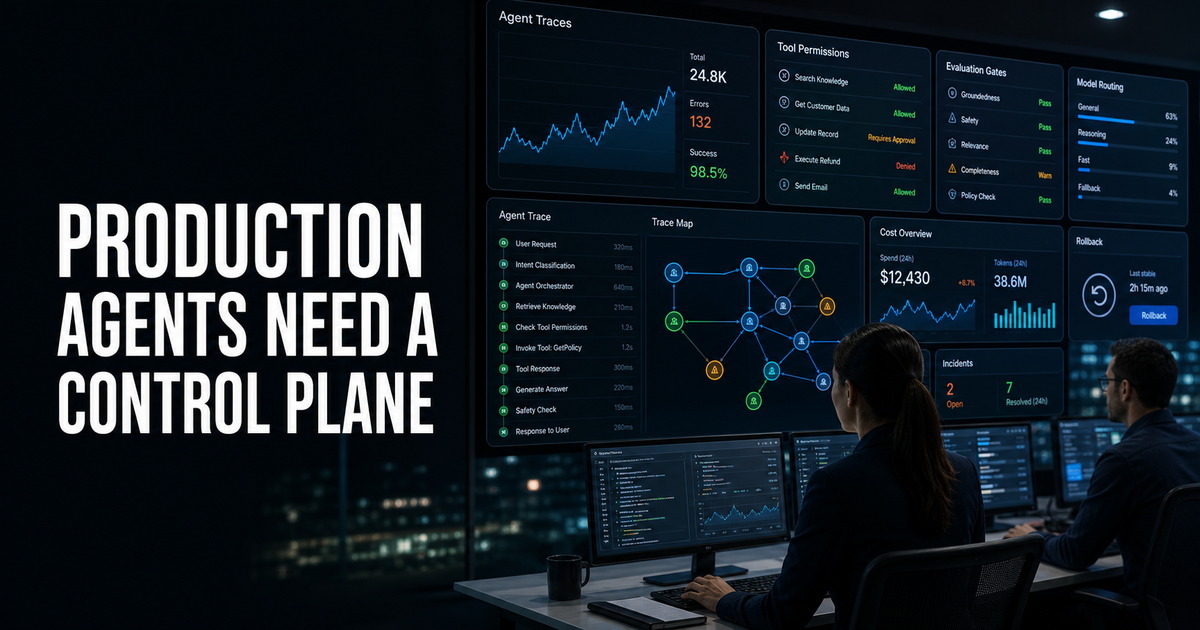
Building through similar complexity?
Discuss the operating decisions behind the essay, or explore where my experience can help.