Egypt Digital Financial Identity Needs Operating Proof
Egypt's digital financial identity platform is not only an onboarding shortcut. Banks need evidence that identity, consent, authentication and data updates work after launch.
In this essay
Egypt has moved digital identity from a useful aspiration into a regulated banking workstream.
On 23 August 2026, the Central Bank of Egypt updated its circular register with rules for the Digital Financial Identity system for banks' electronic KYC. The related CBE announcement says the board approved regulations for the Digital Financial Identity platform to identify bank customers and verify their identities electronically.
That is a material MENA payments and banking signal. It should not be reduced to "remote onboarding is now easier."
The stronger operator question is whether a bank can prove the customer lifecycle after the selfie, document check or digital consent moment. Identity, consent, authentication, product eligibility, data updates, complaints, fraud alerts and account restrictions all need one evidence trail.
The Short Answer
Egypt's Digital Financial Identity platform should be treated as an operating model for customer trust, not only an eKYC tool. The product bar is whether banks can prove who was identified, what was consented to, which authentication event replaced a signature, which product was opened, how customer data was updated, and who owns the exception when the digital journey does not complete cleanly.
Digital onboarding creates access. Operating proof creates confidence.
What Changed
The CBE announcement describes several concrete functions: customers should be able to open bank accounts and obtain banking products through digital channels without visiting a branch; terms and conditions can be accepted electronically; electronic authentication can substitute for handwritten signatures; and customer data updates can be handled through the platform.
The same announcement also says the regulations define governance, roles and responsibilities, technical and operational requirements, data protection and cybersecurity controls.
Those words matter because digital identity is not a front-end feature. It is a cross-bank control surface. A weak implementation can create bad accounts faster, make consent hard to reconstruct, expose data-update risk, or leave support teams unable to explain why a customer was accepted, rejected, blocked or asked for extra evidence.
The CBE's 6 August 2026 financial-inclusion update gives the wider context. It reported that 79% of citizens aged 15 and above owned active accounts by the end of June 2026, equal to 56.4 million citizens out of 71.4 million. A market at that level is no longer solving only first-account access. It is solving quality of access, repeat use, fraud resilience, and dependable digital servicing.
The Product Is The Evidence Chain
I would not launch a digital financial identity journey until the evidence chain is clear.
First, prove identity capture. The bank should know which identity source was used, which document or registry signal was checked, which device participated, what confidence result was returned, and whether a human reviewer changed the decision.
Second, prove consent. The customer should not merely tap through a screen. The record should show the exact product, terms, data use, date, time, language, version, channel and authentication event tied to the customer's acceptance.
Third, prove authentication. If electronic authentication substitutes for a handwritten signature, the operating record needs more than a generic login event. It should connect the identity, device, session, product application, risk decision and final approval.
Fourth, prove data updates. Updating customer data digitally is powerful, but it is also a risk surface. A changed address, phone number, occupation, beneficial-owner detail or income field can affect AML monitoring, limits, communication, collections and customer recovery. The system should retain the old value, new value, source, timestamp, approval path and downstream systems touched.
Fifth, prove the exception. Every digital onboarding product has a grey zone: document glare, mismatched name, stale phone number, expired ID, failed liveness check, duplicate customer record, suspected mule pattern, or customer abandonment. Each state needs an owner, message, timer and next action.
That is the difference between an onboarding flow and a regulated operating model.
Five Gates Banks Should Run
The first gate is identity-source quality. Which data source is authoritative for which customer segment, and what happens when the source is unavailable or contradictory?
The second gate is consent reconstruction. A support, audit or complaint team should be able to reconstruct the exact consent event without asking engineering to read logs.
The third gate is fraud and mule resistance. Faster account opening changes the fraud team's workload. The product needs velocity controls, duplicate checks, device intelligence, risk scoring and escalation paths before scale.
The fourth gate is product eligibility. Digital identity does not mean every product can be sold to every verified customer. Limits, age, residency, risk tier, document type and product rules still matter.
The fifth gate is operational recovery. When a customer cannot complete onboarding, loses access, disputes consent or needs data corrected, the bank should have a clean recovery path that does not push the customer back into branch-only operations by default.
Why Payments Teams Should Care
Payments teams often treat KYC as a compliance prerequisite that happens before the payment product starts. That boundary is too neat.
Identity quality affects wallet limits, account funding, card issuance, account-to-account payment initiation, merchant onboarding, suspicious-activity monitoring, dispute handling and customer support. A digital identity platform can therefore become shared infrastructure for banks and fintechs, but only if the evidence is reusable and trustworthy.
For wallets and payment institutions, the lesson is immediate: account opening is not the end of identity. A payment product needs ongoing confidence in the customer record. A data update, device change or recovered account can be just as important as the first onboarding decision.
For banks, the opportunity is larger. A consistent digital identity layer can reduce branch dependency, speed product access and improve servicing. But it can also concentrate operational risk if the rules are implemented as a compliance form rather than a product system.
The Operator Decision
If I were running this programme, I would build a weekly Digital Financial Identity control room across product, compliance, fraud, cybersecurity, branch operations, support and data governance.
The scorecard would include completed digital account openings, abandonment by step, manual-review rate, false rejection complaints, duplicate-customer detections, fraud alerts, time to resolve identity exceptions, data-update reversals, support contacts per 10,000 onboarding attempts, and audit retrieval time for consent events.
None of those metrics is glamorous. That is the point. Digital identity earns trust when the bank can explain its decisions under pressure.
The operator question for banks, fintechs and payment providers is simple:
Can one case file show identity source, consent version, authentication event, product approval, data updates and exception owner without a branch visit or a log hunt?
If yes, digital financial identity is becoming infrastructure.
If no, it is still an onboarding shortcut with an operating-risk backlog behind it.
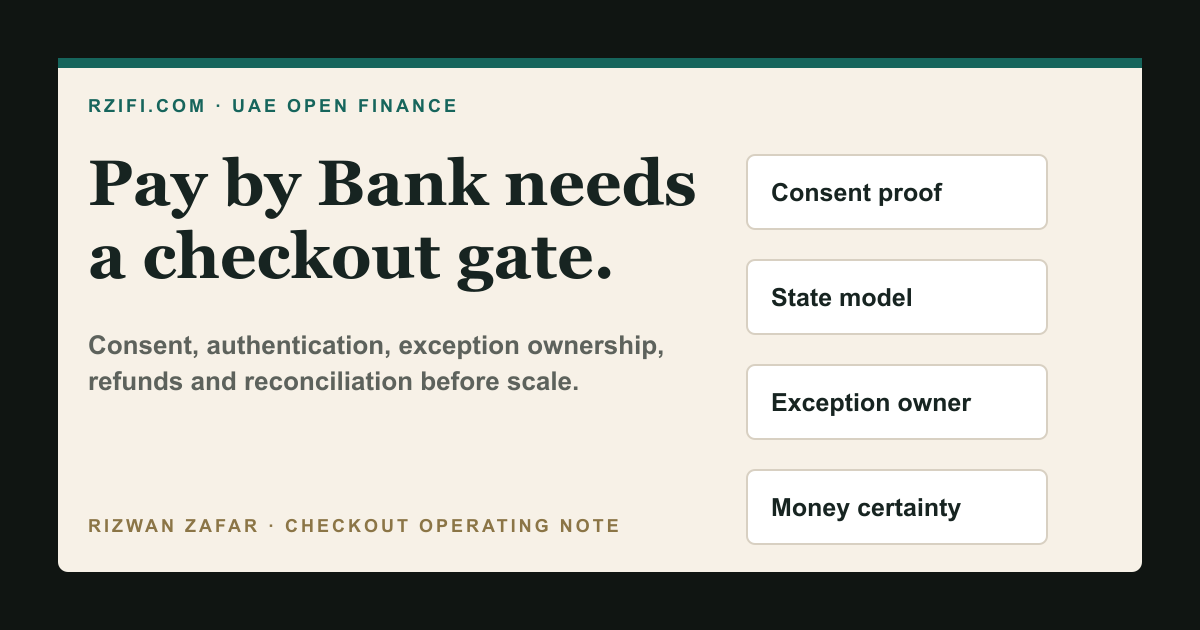
For adjacent operating models, read KYC conversion designed together, merchant onboarding across growth and risk, and UAE Open Finance checkout gates. For help designing customer identity, onboarding and payment-control evidence, start at /hire/.
FAQ
Does this mean every Egyptian bank account can now be opened fully digitally?
No. The official CBE material describes approved regulations and the Digital Financial Identity platform's intended role. Treat bank availability, product scope and customer eligibility as implementation questions that must be verified with the relevant institution.
Is eKYC only a compliance workflow?
No. It starts in compliance, but the operating consequences reach fraud, limits, support, account recovery, product eligibility, data updates and payment monitoring.
What should banks measure first?
Start with completed onboarding, manual-review rate, exception ageing, fraud alerts, consent-reconstruction time, data-update reversals and support contacts per 10,000 onboarding attempts.
Sources
Closing thought and further reading
Egypt's digital financial identity platform is not only an onboarding shortcut. Banks need evidence that identity, consent, authentication and data updates work after launch.
Ideas that continue the thread.
View all essays
Building through similar complexity?
Discuss the operating decisions behind the essay, or explore where my experience can help.