Jaywan Acceptance Needs Payment Evidence, Not Just Logos
Jaywan acceptance is no longer only a scheme-launch claim. The useful operator question is whether merchants, acquirers, issuers and the network can prove what happened after every payment.
In this essay
Jaywan is moving from scheme rollout into acceptance proof.
That is a different operating problem.
In July, the Central Bank of the UAE said nationwide issuance of Jaywan cards had started in phases through banks, licensed financial institutions and exchange houses. Since then, the acceptance trail has become more concrete. Network International announced Jaywan acceptance for online payments. Majid Al Futtaim said it had enabled Jaywan across more than 200 UAE destinations. Al Etihad Payments and UnionPay International signed an MoU to enable global acceptance of Jaywan mono-badged cards through the UnionPay network. On 19 August 2026, Etihad Airways said it had become the first airline to accept Jaywan payments.
Those are useful signals. They should still be handled with discipline.
An airline, a retail estate, an online acquiring gateway and an international network MoU do not prove the same thing. They expose different parts of the acceptance stack: checkout choice, terminal or ecommerce certification, routing, authorization, refunds, dispute evidence, settlement and reconciliation.
The Short Answer
Jaywan acceptance should now be managed as a payment-evidence programme. The material question is not whether another merchant logo can be added. It is whether the issuer, acquirer, merchant, gateway and scheme operator can explain one transaction from checkout attempt to ledger entry without losing the rail, reason code, settlement path or customer message.
Logo acceptance creates reach. Evidence creates trust.
Why This Is Not The Same As The Launch Story
The 20 July launch story was about national-scheme rollout. It asked whether Jaywan was moving into the market with issuing, domestic acceptance and the right participant readiness.
The new acceptance evidence asks a narrower question: what does production look like when real merchants and travel use cases start carrying the rail?
Airline payments are not simple retail payments. They involve ecommerce checkout, booking references, delayed fulfilment, refunds, reversals, chargeback evidence, currency presentation, agency flows and customer-service escalations. A failed payment can leave the customer unsure whether a seat is held, an itinerary is ticketed, or a retry will create a duplicate charge.
Large retail estates have a different shape. The store, point-of-sale estate, ecommerce site, loyalty layer, acquirer, processor and finance team all need the same transaction story. If a customer pays with a domestic card scheme at one store and asks for a refund at another touchpoint, the rail and evidence must travel with the case.
Online acquiring adds a third shape. The gateway has to prove payment-method presentation, authentication behaviour, authorization outcome, decline reason, capture status, refund path and settlement reference. If the merchant only sees an approval or decline, the new scheme stays hidden inside the acquirer stack.
The UnionPay MoU adds a fourth shape. AEP described an enablement plan for global acceptance of Jaywan mono-badged cards through UnionPay's network. That is not the same as saying every mono-badged card is already accepted everywhere. It is a control agenda: certification, routing, cross-border rules, FX treatment, settlement arrangements, exception ownership and customer communication all need proof before the promise is simplified.
The Evidence Pack I Would Require
For each meaningful Jaywan acceptance rollout, I would ask for one compact evidence pack.
First, show the checkout state. Where is Jaywan presented, how is it described, and what does the customer see when the transaction is approved, declined, pending, reversed or retried?
Second, show the routing state. Is the transaction Jaywan-only, co-badged domestic, partner-network international or fallback traffic? Which field tells operations the answer without manual investigation?
Third, show the authorization state. Which issuer, gateway, processor and risk rule participated? What reason code is shown to the merchant and what message is shown to the customer?
Fourth, show the money state. Which settlement file, account entry, fee record, refund entry and reconciliation reference proves that the merchant got paid or that the customer was refunded?
Fifth, show the support state. Can a frontline agent explain a failed booking, unmatched retail receipt, duplicate attempt or delayed refund without escalating to three separate teams?
That evidence pack is intentionally practical. It turns acceptance from a marketing milestone into an operating control.
Five Metrics That Matter More Than Logo Count
The first metric is successful payment rate by channel: store, ecommerce, app, airline booking, wallet and ATM should not be blended into one success number.
The second is issuer-decline mix. Product teams need to know whether failures are caused by card status, insufficient funds, risk rules, unsupported flow, authentication, network routing, merchant configuration or customer abandonment.
The third is refund completion time. A new acceptance rail earns trust when a customer can reverse a transaction without support chaos.
The fourth is automatic reconciliation match rate. If finance cannot match the booking, order, payment reference and settlement record, speed at checkout has only moved the workload downstream.
The fifth is support contacts per 10,000 Jaywan attempts. This is where weak customer messaging, duplicate retries and unclear pending states become visible.
These metrics are useful precisely because they cut across organisational boundaries. They force issuers, acquirers, processors, merchants and the scheme operator to look at the same payment, not their own comfortable slice of it.
The Operator Decision
I would not treat each Jaywan acceptance announcement as a separate win to celebrate and forget.
I would build a shared acceptance-readiness board across the largest merchant estates, ecommerce gateways, wallets, airlines and international partner routes. Each rollout should be marked untested, certified, live under controlled volume, scaled, or exception-stable. "Live" should not mean "no one complained this week." It should mean the team can produce the transaction evidence when something fails.
The same discipline applies to international acceptance. The UnionPay MoU is strategically important because it gives Jaywan a pathway beyond domestic acceptance. But the product promise should stay conditional until availability, routing, settlement and support evidence are clear for the customer segment being served.
Jaywan can become real infrastructure when payment teams stop asking only "where is it accepted?" and start asking "who can prove what happened?"
The operator question for banks, acquirers, airlines, retailers and payment networks is simple:
When a Jaywan payment fails, refunds or settles late, can one case file show the checkout state, rail, reason code, settlement reference and customer message?
If yes, acceptance is becoming infrastructure.
If no, acceptance is still a logo with an operations backlog behind it.
For adjacent operating models, read the Jaywan scheme-migration control room, BIN routing and scheme selection, and three-way reconciliation at scale. For help designing payment acceptance evidence across issuers, acquirers and merchants, start at /hire/.
FAQ
Does this mean every Jaywan card now works globally?
No. The UnionPay source describes an MoU to enable global acceptance of Jaywan mono-badged cards through the UnionPay network. Treat it as an enablement plan and recheck availability, issuer scope and geography before making a customer-facing claim.
Why does Etihad Airways matter to payments operators?
An airline use case tests ecommerce checkout, booking references, refunds, fulfilment, support and cross-border customer expectations. It is a richer operating test than a simple card-present purchase.
What should merchants measure first?
Start with successful payment rate, decline reasons, refund completion time, automatic reconciliation match rate and support contacts per 10,000 Jaywan attempts. Those metrics expose whether acceptance is dependable after the logo appears.
Sources
- Central Bank of the UAE: Mansour bin Zayed inaugurates Jaywan, the UAE's first national card scheme
- Network International: Network International rolls out UAE's Jaywan card acceptance for online payments
- Majid Al Futtaim: Among the first companies to enable Jaywan acceptance
- Al Etihad Payments: Al Etihad Payments and UnionPay International sign an MoU to enable global acceptance of Jaywan mono-badged cards
- Etihad Airways: Etihad Airways becomes the first airline to accept Jaywan payments
Closing thought and further reading
Jaywan acceptance is no longer only a scheme-launch claim. The useful operator question is whether merchants, acquirers, issuers and the network can prove what happened after every payment.
Ideas that continue the thread.
View all essays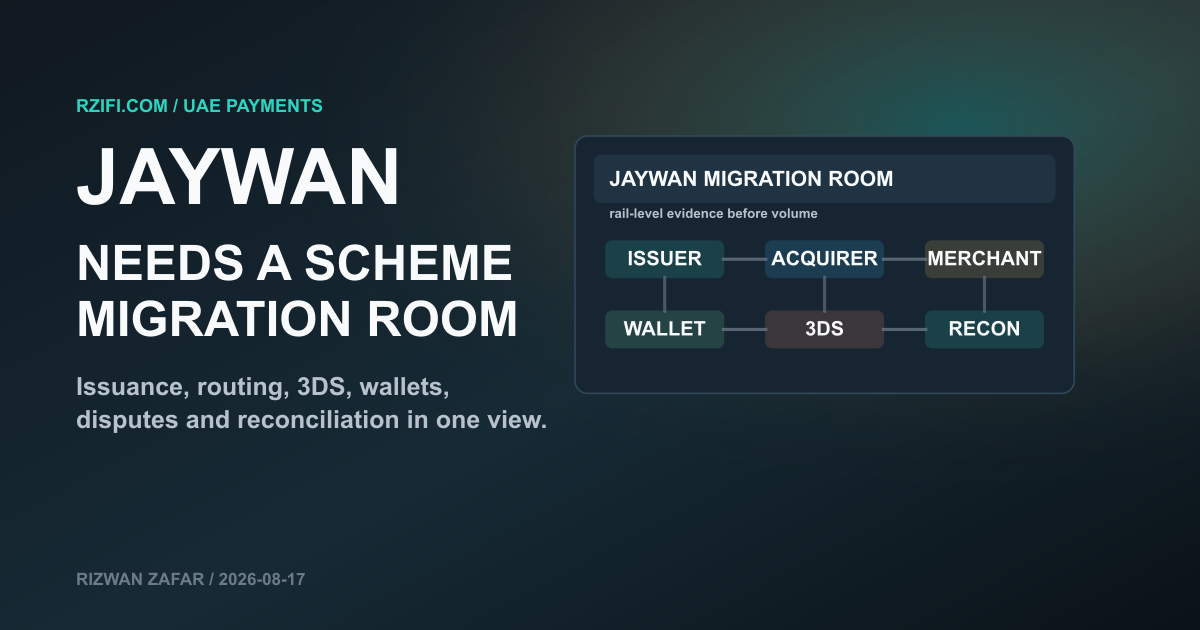
Building through similar complexity?
Discuss the operating decisions behind the essay, or explore where my experience can help.