Microsoft Project Perception Makes Security Agents an Operating Model
Agentic security is not a model launch. It is an operating model where signals, context, model routing, agent identity, permissions, actuators, and human control have to be designed as one system.
In this essay
The wrong question is whether security teams need AI agents.
They already do, if the threat surface is moving faster than the analyst queue.
The better question is whether the agents have an operating model. On July 27, 2026, Microsoft published Rethinking security for the age of AI, describing Project Perception, MAI-Cyber-1-Flash, and a "Cyber Stack" for agentic security. Microsoft says the first scenario is software vulnerability management, with MAI-Cyber-1-Flash inside MDASH, and that Project Perception enters public preview on August 3, 2026.
The useful part is not the benchmark headline. It is the stack shape: signals, context, models, harness, agents, actuators, and control.
That is the difference between shipping a clever security assistant and changing how cyber work gets done.
The Short Answer
Agentic security needs an operating model before it needs more autonomy. The product should define which signals the agent can see, which context it can trust, which model handles each task, which identity and permissions the agent uses, which actions it can take, when it escalates, and how every decision is audited.
Without that model, security agents become another alert source.
Model Routing Is A Product Decision
Microsoft's post says Project Perception uses a multi-model architecture because no single model is optimal for every security task. It also says the MAI-Cyber-1-Flash configuration delivers 96% on CyberGym and almost 50% cost savings versus the current MDASH configuration in market today.
Treat those numbers as Microsoft's claim, not a universal operating baseline. The product lesson is still strong.
Security work is too expensive and too continuous for "send everything to the biggest model" to survive procurement review. Vulnerability triage, alert enrichment, exploit reasoning, remediation planning, evidence gathering, and executive summaries have different latency, cost, and accuracy profiles.
The product leader has to decide:
- which tasks need a specialist cyber model;
- which tasks need a frontier model;
- which tasks can use cheaper extraction or classification;
- which tasks require human review before action;
- which failures should retry, degrade, or stop.
That is model routing as product management. It belongs in the roadmap, budget, and risk register, not only in the prompt layer.
Context Is The Real Moat
Microsoft argues that agents need security context: a shared representation of assets, identities, relationships, risks, and activities across the digital estate.
That is exactly right.
An agent that sees an alert but not the asset owner, customer impact, deployment history, privilege boundary, business criticality, prior incidents, open change ticket, and compensating control will either overreact or underreact. More tokens do not fix missing context.
For a fintech or payments operator, the context graph should include payment systems, card processing, ledger services, vendor integrations, KYC/KYB systems, fraud tools, settlement jobs, customer-impact tiers, and regulatory reporting dependencies.
Security context is not a data lake. It is the product's working memory of what matters when a machine proposes an action. It also keeps AI escalation paths from becoming generic routing rules.
Agents Need Identity And Permissions
Microsoft's Security Copilot agents overview is more practical than most launch coverage. It says agents respond to triggers, use permissions, need an identity, and may use plugins or connectors for context. It also describes options such as a dedicated agent identity or using an existing user account.
That distinction matters.
If an agent inherits a human user's permissions, the audit trail can become ambiguous. If it has its own identity, the organization can scope access, rotate credentials, constrain actions, and review behavior as a separate operational actor.
For production security agents, I would want:
- a named agent identity;
- least-privilege access by workflow;
- separated read and write permissions;
- approval thresholds for irreversible actions;
- explicit data-retention rules;
- an owner for every plugin;
- an audit trail that survives vendor-console changes.
This is the same control logic behind production agent control planes. An agent is not a feature if nobody can say what it is allowed to do.
Actuators Change The Risk Profile
The Microsoft blog uses the word actuators for the layer that turns insights into actions across Microsoft Security products.
That is where agentic security becomes real.
Summarizing an incident is one risk profile. Disabling a user, quarantining a device, changing a conditional access policy, creating a ticket, closing an alert, or pushing a remediation plan is a different risk profile. The product should treat those actions as controlled operations with permissions, thresholds, and rollback.
The operating model should separate:
- observe actions, such as enrichment and summary;
- recommend actions, such as remediation plans;
- prepare actions, such as drafting policy changes;
- execute actions, such as containment or configuration updates.
Each layer needs a different approval path. A fintech SOC may allow an agent to enrich every alert but require human approval before touching a payment-production identity, ledger job, fraud rule, or customer-facing service.
The Scorecard I Would Run
For agentic security in a fintech environment, I would measure:
- mean time from signal to triage decision;
- false positive and false negative rates by workflow;
- percentage of actions taken in observe, recommend, prepare, and execute modes;
- model cost per investigated incident;
- escalation rate by severity and asset class;
- human override rate and reason;
- rollback rate after agent-prepared actions;
- incidents where missing context changed the decision;
- permission-denied attempts by agent identity;
- audit completeness for every agent action.
The point is not to prove that agents are impressive. The point is to prove they reduce risk without creating a second control problem.
What Fintech Leaders Should Try Next
Do not start by automating containment.
Start with one narrow workflow: vulnerability triage for a non-customer-facing service, alert enrichment for a single fraud-support system, or incident-summary drafting after a known runbook. Give the agent read access first. Measure decision quality, context gaps, escalation behavior, and cost. Then add prepared actions with human approval.
Only after that should the team discuss autonomous execution.
If your security, risk, or platform teams are experimenting with AI agents, work with Rizwan to define the operating model: context, model routing, agent identity, permissions, escalation, scorecards, and governance before the agents touch production controls.
Operator Takeaway
Microsoft Project Perception is a useful AI signal because it frames security agents as a stack, not a chatbot.
The debate point: if an agent proposes a security action in your production environment, can you prove what it saw, which model reasoned over it, which identity acted, and who owned the risk?
FAQ
What is Microsoft Project Perception?
Microsoft describes Project Perception as an agentic security system that uses signals, security context, models, a harness, agents, and actuators to support security workflows such as software vulnerability management.
Why does model routing matter for security agents?
Different security tasks have different cost, latency, reliability, and accuracy needs. A specialist cyber model may be appropriate for some work, while higher-cost frontier models should be reserved for harder decisions.
What should fintech teams control first?
Start with agent identity, permissions, context sources, action tiers, escalation rules, and audit evidence before allowing autonomous execution against production systems.
Closing thought and further reading
Agentic security is not a model launch. It is an operating model where signals, context, model routing, agent identity, permissions, actuators, and human control have to be designed as one system.
Ideas that continue the thread.
View all essays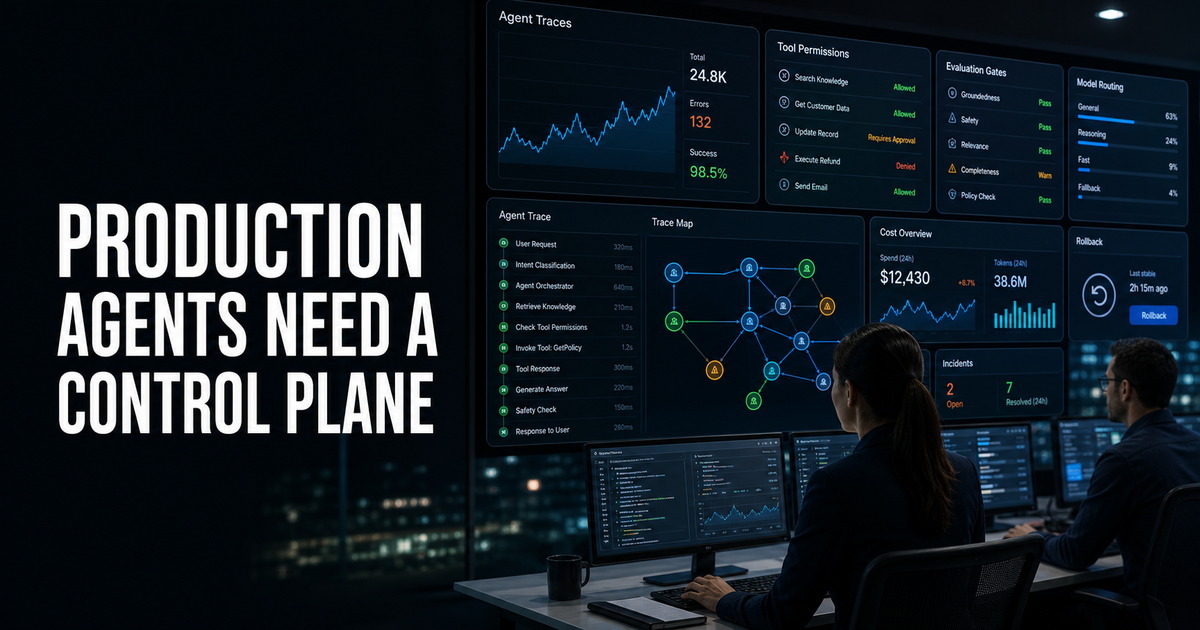
Building through similar complexity?
Discuss the operating decisions behind the essay, or explore where my experience can help.