ScotPayments 2.0 Shows Migration Is a Resilience Programme
ScotPayments 2.0 is a useful programme-management case because the migration was not only a cloud upgrade. It moved live payment services and operational data while protecting public-sector payment continuity.
In this essay
Payment migrations fail when teams treat them as infrastructure moves with a launch date.
The better framing is harsher: a live payment migration is a resilience programme with a technology component.
On July 27, 2026, the Scottish Government published an update on strengthening the foundations of ScotPayments. The update said ScotPayments 2.0 had launched, moving the service to a more modern platform with stronger recovery, demand handling, deployment practices, onboarding capability, file-processing performance, and support for future payment methods.
The key delivery detail is not the cloud language. The post says the transformation required migration of live payment services and operational data while organisations continued to make business-critical payments. It also says the migration completed with no unplanned downtime and no failed payments during the transition.
That is the programme story.
The Short Answer
A payment-platform migration should be governed around continuity, evidence, and operating readiness, not only technical cutover. The release is ready when payment files, live data, supplier dependencies, security controls, monitoring, rollback, support, and customer communication have all cleared explicit gates.
Cloud migration is the venue. Payment continuity is the outcome.
Why ScotPayments Is A Useful Case
Gov.scot describes ScotPayments as a shared system built by the Scottish Government for public-sector use. It lets public bodies make payments to people and organisations, works with existing organisational technology, and includes a bank-detail verification service called Confirmation of Payee.
That shape matters. ScotPayments is not a marketing checkout. It supports public-sector obligations: salaries, supplier payments, and payments to people in Scotland. When that type of platform moves, the risk is not only technical incident cost. The risk is people and organisations not receiving money they expect.
That is why the programme-management lens should focus on continuity.
The Scottish Government update names the workstreams implicitly:
- live payment services;
- operational data migration;
- cloud-native architecture;
- testing and assurance;
- security reviews;
- operational readiness;
- supplier and service-provider coordination;
- monitoring and operational processes.
Those are not checklist items. They are gates.
Migration Gates Beat Migration Status Reports
Most migration status reports say green until the first cutover weekend. A stronger PMO asks which gates have objectively passed.
For a payment migration like ScotPayments 2.0, I would expect gates such as:
- payment file compatibility proven across representative partners;
- live-data reconciliation complete before and after migration;
- cutover sequence timed and rehearsed;
- rollback decision point defined before production;
- monitoring dashboards tested with synthetic failures;
- incident rota staffed and empowered;
- supplier handoffs documented;
- security controls reviewed against the new architecture;
- customer and partner communications approved;
- post-cutover hypercare schedule agreed.
The difference is evidence. A gate either has proof or it does not.
This is the same principle behind the GOV.UK Pay migration: success is not a heroic migration weekend. It is a sequence of operationally meaningful gates.
Resilience Is Not A Non-Functional Requirement
Payment programmes often bury resilience under "NFRs." That is a mistake.
The Scottish Government update says ScotPayments 2.0 is better able to recover from disruption and support updates without interrupting users or payment operations. It also cites faster processing for large payment volumes and lower cloud-computing costs.
Those outcomes should be treated as programme requirements:
- recovery time and recovery point objectives;
- deployment without user disruption;
- file-processing duration;
- autoscaling behavior;
- operational cost per payment or batch;
- incident detection and resolution time;
- onboarding cycle time for new organisations.
If resilience is left as a technical appendix, the steering committee will approve the wrong thing. It may approve "migration complete" before the operating model has proven it can handle stress.
Supplier Coordination Is A Delivery Risk
The ScotPayments post thanks engineering, cloud operations, service management, cybersecurity, security operations, architecture, testing, delivery, suppliers, and partners.
That list is a programme map. Every named group can block continuity if its role is unclear.
The delivery risk is not that suppliers exist. The risk is that supplier boundaries are invisible during cutover:
- who owns the network path;
- who owns the data-migration script;
- who signs off monitoring;
- who can approve rollback;
- who communicates with partner organisations;
- who handles incidents after the initial release.
In payments, "we are waiting on the vendor" is not a plan. A PMO should turn every supplier dependency into an owner, evidence artifact, decision point, and escalation path.
That is the same operating pattern in Mambu Swift connectivity: scheme and platform connectivity only works when the handoffs are governed.
The Scorecard I Would Run
For a payment-platform migration, I would track:
- payment files processed successfully during cutover and hypercare;
- failed payment count and value;
- reconciliation breaks by source system;
- file-processing time before and after migration;
- deployment interruption minutes;
- incidents by severity and owning team;
- rollback readiness test result;
- partner onboarding time after migration;
- security findings opened and closed;
- operating cost per payment batch;
- support tickets by partner and root cause.
The point is not to prove perfection. The point is to show that the new platform is measurably easier to operate than the old one.
What Programme Leaders Should Try Next
Before your next payment migration, write the launch decision as if the board will read it after an incident.
It should say:
- what payment obligations are protected;
- what data was reconciled;
- what failure modes were tested;
- what rollback path exists;
- who owns each post-launch control;
- what metrics define a stable platform.
If that decision cannot be written clearly, the programme is not ready.
If your team is planning a payment migration, platform modernization, scheme rollout, or critical-service cutover, work with Rizwan to build the delivery gates, PMO rhythm, and resilience scorecard before the migration date becomes the plan.
Operator Takeaway
ScotPayments 2.0 is useful because it frames migration as public-service continuity, not cloud modernization theater.
The debate point: if your payment migration went live tomorrow, would your steering committee be approving a technical deployment or an evidenced resilience programme?
Sources
- Scottish Government Digital Blog: Strengthening the Foundations of ScotPayments
- Gov.scot: ScotPayments factsheet
- Scott Logic: Scottish Government full-service programme delivery
FAQ
What is ScotPayments?
ScotPayments is a Scottish Government payment service for public-sector organisations to make payments to people and organisations, with shared platform capabilities and bank-detail verification.
What made ScotPayments 2.0 a programme-management signal?
The migration moved live payment services and operational data while continuing business-critical payments, with explicit attention to resilience, cloud operations, security, testing, suppliers, and operational readiness.
What should PMOs copy from this case?
Use evidence-based gates for data reconciliation, cutover rehearsal, rollback, monitoring, supplier handoffs, security readiness, and post-launch hypercare.
Closing thought and further reading
ScotPayments 2.0 is a useful programme-management case because the migration was not only a cloud upgrade. It moved live payment services and operational data while protecting public-sector payment continuity.
Ideas that continue the thread.
View all essays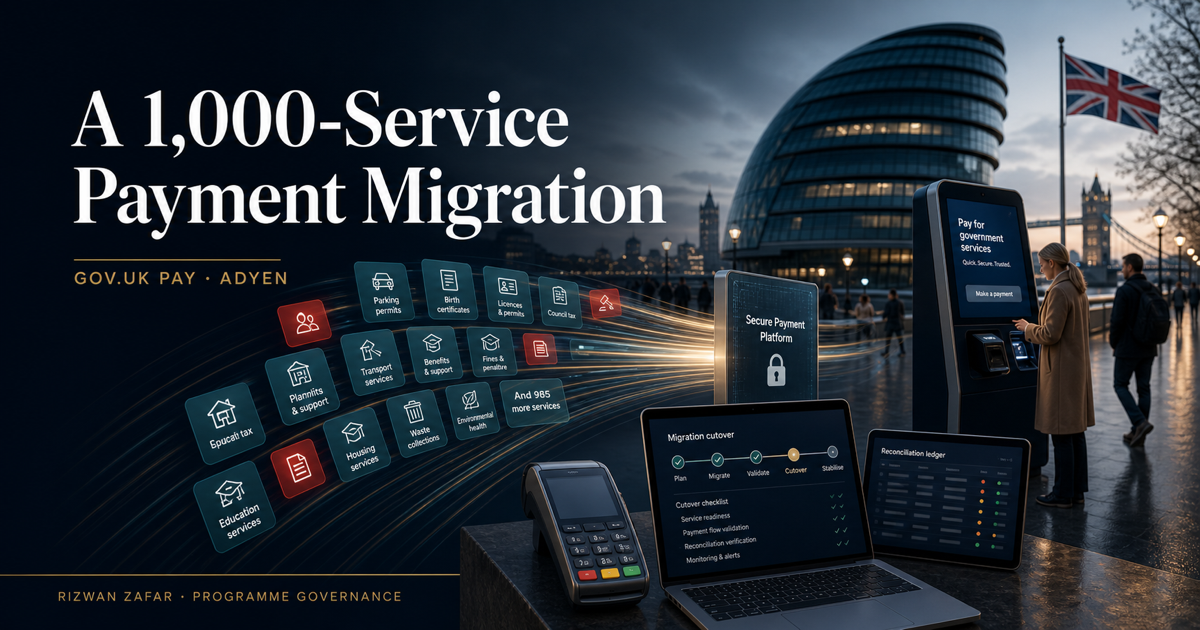
Building through similar complexity?
Discuss the operating decisions behind the essay, or explore where my experience can help.