In this essay
Payments migrations are rarely won in the press release.
They are won in the readiness gates.
On 15 July 2026, EPI said the first phase of the iDEAL to Wero migration had been completed. EPI's roadmap points toward Dutch issuing-bank connectivity in October 2026, gradual transition of iDEAL payments to Wero infrastructure, and a shared objective to complete the migration by 31 December 2027. EPI also says Wero scheme pricing will remain broadly aligned with current iDEAL | Wero pricing until 31 December 2028.
That is a programme-management story.
The Short Answer
The iDEAL to Wero migration needs delivery gates across banks, PSPs, merchants, customer experience, pricing, support, resilience, reconciliation, and rollback. The safest programme is not the one with the prettiest roadmap. It is the one that can prove each gate before volume moves.
This is exactly where payment PMOs earn their keep.
Why This Migration Is Hard
iDEAL is not a niche checkout option in the Netherlands. It is trusted, familiar, and embedded into merchant operations, PSP integrations, banking apps, support scripts, reconciliation flows, refunds, and customer expectations.
Wero is more ambitious. ABN AMRO describes the transition as a move toward a European digital wallet, with the iDEAL brand gradually moving into iDEAL | Wero and then Wero. Wero's own merchant-facing page positions the shift as a path toward broader features such as subscriptions, event-based payments, Buy Now Pay Later, refunds, and peer-to-peer payments.
That means the migration is not just a brand swap.
It is a live payment-scheme transition with multiple participant groups:
- issuing banks;
- acquiring banks;
- PSPs;
- merchants;
- ecommerce platforms;
- support teams;
- finance and reconciliation teams;
- consumers who still expect the payment to feel familiar.
Every group can be "ready" in a different way. That is the danger.
Gate One: Scheme And Bank Readiness
The first gate is infrastructure readiness.
Can all participating issuing banks process Wero-backed iDEAL traffic at the required reliability, latency, authentication, and exception standards? Are issuer response codes mapped correctly? Are cutover windows documented? Are scheme-rule differences understood by operations, not only by architects?
This gate should not pass on integration completion alone.
It should pass when the programme can show:
- successful certification evidence;
- volume and resilience tests;
- exception-handling traces;
- fraud and dispute pathways;
- incident ownership by participant;
- rollback criteria and named decision-makers.
If the bank layer is not provable, merchant readiness will be theatre.
Gate Two: PSP And Merchant Readiness
PSPs carry the market.
EPI's announcement quotes PSP and merchant representation as central to the migration. That is not cosmetic. PSPs translate scheme changes into merchant reality: APIs, checkout labels, settlement files, refunds, reconciliation, reporting, and support.
The PSP gate should ask:
- which merchant segments are ready first;
- which plugins and platforms need updates;
- how the checkout label and customer flow change;
- whether refunds, cancellations, and disputes behave differently;
- whether settlement reporting changes field names, references, timing, or fees;
- how merchants prove they have updated terms, support scripts, and finance processes.
The quiet risk is not that the logo changes. The quiet risk is that the merchant's back office cannot explain a transaction after the logo changes.
Gate Three: Customer Experience Continuity
EPI says the consumer transition should remain largely seamless.
That is a measurable promise.
Customer-experience continuity should have its own gate:
- payment completion rate before and after each migration wave;
- drop-off at bank handoff;
- customer-support contact rate;
- failed payment reasons by bank and PSP;
- mobile-app deep-link success;
- repeat customer behavior after first Wero-backed payment;
- merchant complaints about checkout confusion.
If consumers do not notice the migration, the programme should be able to prove it through data.
If consumers do notice it, the programme needs a communication and fallback plan before the next wave.
Gate Four: Commercial And Support Stability
Pricing stability matters because it reduces one class of migration resistance. EPI's statement that scheme pricing will remain broadly aligned until the end of 2028 gives participants time to move without turning every readiness meeting into a commercial renegotiation.
But pricing is only one part of stability.
Support must also be stable. That means:
- clear incident severity levels;
- one place for PSPs to escalate;
- merchant-facing support scripts;
- bank and PSP operating hours during cutover waves;
- post-migration defect triage;
- a visible decision log for changes.
A migration of this kind can fail slowly. A confusing refund path, a reconciliation mismatch, or a support ownership gap can erode trust even when authorization rates look fine.
The PMO Pattern
The right PMO structure is wave-based and evidence-led.
I would run it with five artifacts:
- a participant readiness register;
- a scheme and API change log;
- a migration wave plan by PSP, bank, and merchant segment;
- a live incident and rollback decision log;
- a post-wave scorecard that compares completion, drop-off, support, refunds, and settlement exceptions.
No gate should pass by optimism. Each one needs a named owner, evidence, and a stop condition.
That sounds heavy until you remember the alternative: reconstructing evidence after a payment method millions of consumers trust starts behaving differently.
Operator Takeaway
The iDEAL to Wero migration is a useful reminder that payment migrations are not primarily technical projects.
They are market-coordination programmes.
The debate point: when a payment migration involves banks, PSPs, merchants, and consumers, should the programme celebrate the first successful phase, or should it ask the harder question - which gate would stop the next wave if the data turns yellow?
Discuss regulated payment programme delivery or review related work on payment migration gates, GOV.UK Pay programme delivery, and RAID/SteerCo discipline.
Closing thought and further reading
The iDEAL to Wero migration will be judged less by the announcement and more by whether each participant can prove readiness before traffic moves.
Ideas that continue the thread.
View all essays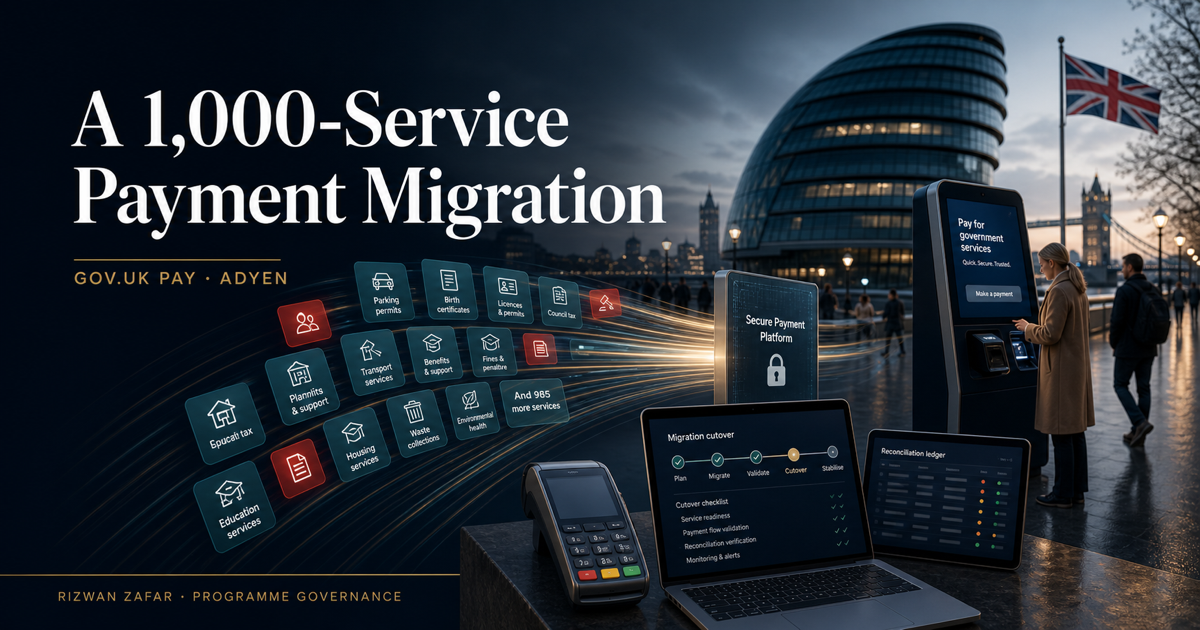

Building through similar complexity?
Discuss the operating decisions behind the essay, or explore where my experience can help.