Solana Pay Shows Agent Payments Need Wallet Approval Controls
Solana Foundation's pay CLI is a repo-radar signal for agentic payments: the useful product boundary is not automatic payment, but local wallet approval, policy checks, receipts, and denial before signing.
In this essay
Agent payments are moving from conference idea to developer surface.
That makes one product boundary more important than the protocol debate: what happens before money is signed?
The Solana Foundation pay repository is a useful repo-radar signal because it makes that boundary visible. The project describes itself as a CLI for agentic payments across x402, MPP, and AP2. Its README shows a simple pattern: without the tool, an API can return HTTP 402; with the tool, the CLI handles the payment challenge, asks a local wallet to authorize and sign, and retries the request with payment proof.
That is a small developer workflow with a large governance implication.
The Short Answer
Agent payments should be designed around approval before signing, not just automatic payment after a 402 response. The product owner needs spend policies, expected resource checks, idempotency, receipts, denial paths, and audit joins before letting agents pay APIs or services.
The wallet prompt is not friction. It is the control point.
What The Repo Makes Concrete
The pay CLI is not a bank-grade operating model by itself. It is a developer tool. That is why it is useful.
It shows how an agent or command-line workflow can encounter a paid resource, parse the payment requirement, prepare the transaction, ask the local wallet for authorization, and then retry. The public README also shows sandbox usage and an agent path through pay claude.
That turns agent payment from a vague "future of commerce" story into a sequence a product team can inspect:
- request a resource;
- receive a payment requirement;
- decide whether the requirement is acceptable;
- authorize and sign with a wallet;
- retry with proof;
- keep a record.
Only step four moves money. The product work sits before and after it.
x402 Shows The Risk
The x402 MCP guide explains how an MCP server can bridge an agent client to a paid API. It says the server detects a 402 response, handles payment through a wallet, and returns the paid data to the client. The same guide warns that production implementations should check payment requirements before creating or signing a payload.
That warning is the whole issue.
If an agent can call tools, read untrusted content, follow redirects, invoke APIs, and pay automatically, then the payment decision is not only financial. It is also an authorization, identity, fraud, and prompt-injection boundary.
The model should not be trusted to decide spend authority from text alone. The payment client needs deterministic rules close to the signing action.
The Controls I Would Require
For a fintech or AI platform experimenting with paid API calls, I would not start with a large wallet balance.
I would start with a narrow mandate object.
Resource: which server, endpoint, tool name, and facilitator can request payment.
Amount: maximum amount, currency, fee, and daily or session budget.
Context: user, agent, task, approved operation, and whether the agent is in a test or production environment.
Timing: expiry, retry limits, duplicate-payment detection, and idempotency key.
Evidence: payment requirement, decision, signature result, receipt, tool output, and final business event.
Deny path: what the agent does when payment is blocked, requires approval, or fails after signing.
Without that mandate, automatic payment becomes a support and incident problem.
Why Approval UX Matters
Payment people sometimes under-rate user experience in control design. AI teams sometimes under-rate financial controls in agent UX. Agent payments need both.
A useful approval prompt should not show raw protocol fields and ask the user to guess. It should say: this agent wants to spend this amount, in this currency, with this merchant or resource server, for this task, under this policy, using this wallet, with this retry behavior.
That prompt should also explain the consequence of denial. Will the agent stop, choose a free source, request human approval, or continue without paid data?
The product decision is not "auto-pay or manual." The better decision is which payments can be pre-approved, which require step-up approval, and which must be blocked.
That is the same pattern card teams already know from authorization controls, merchant category limits, velocity checks, and delegated spend.
Where PaySentry Fits
The PaySentry repository points at the adjacent control layer: spending limits, approval rules, circuit breakers, observability, and audit trails for agent payments across protocols such as x402 and AP2. It is early software with a small public footprint, so I would not treat it as a proven standard.
I would treat it as evidence of where the market is going.
Once agents can pay, teams will need policy engines, transaction history, dispute paths, and circuit breakers. Otherwise every failed paid API call becomes a forensic exercise: what did the agent intend, what did the server request, what did the wallet sign, what settled, and which user or policy approved it?
The Product Scorecard
For an agent-payment pilot, I would measure more than successful paid calls.
The scorecard should include payment attempts, allowed payments, blocked payments, approval step-ups, duplicate attempts, failed settlements, refunds or reversals, average cost per task, spend by agent, denied-resource frequency, policy exceptions, and receipt join rate.
The receipt join rate matters. If the product cannot join the agent task to the payment proof to the returned data to the user outcome, it cannot govern the system.
What To Try Next
The safest first pilot is not broad agent shopping or autonomous procurement.
It is a paid internal API with a tiny budget, a clear task, a sandbox wallet, explicit policy checks, and full logging. For example, let an agent buy a low-cost enrichment result only when the user has requested that exact enrichment and the price is below a fixed cap.
Then inspect the denied attempts as carefully as the allowed ones.
The decision test is simple: before an AI agent signs a payment, can the product show the expected resource, amount, user intent, policy result, wallet authority, idempotency key, and receipt path?
If not, the agent is not ready to spend real money.
Relevant proof paths: x402 payment guardrails, agentic card mandate controls, and agent metrics governance. For help designing AI payment controls inside fintech products, start at /contact/.
FAQ
What is the Solana Foundation pay repo?
It is a CLI for agentic payments that can handle paid API challenges across protocols such as x402, MPP, and AP2, using local wallet authorization before payment proof is sent.
Why do agent payments need approval controls?
Because an AI agent can misunderstand instructions, follow untrusted content, retry incorrectly, or pay the wrong resource. Policy checks before signing keep authority close to the wallet.
Sources
Closing thought and further reading
Solana Foundation's pay CLI is a repo-radar signal for agentic payments: the useful product boundary is not automatic payment, but local wallet approval, policy checks, receipts, and denial before signing.
Ideas that continue the thread.
View all essays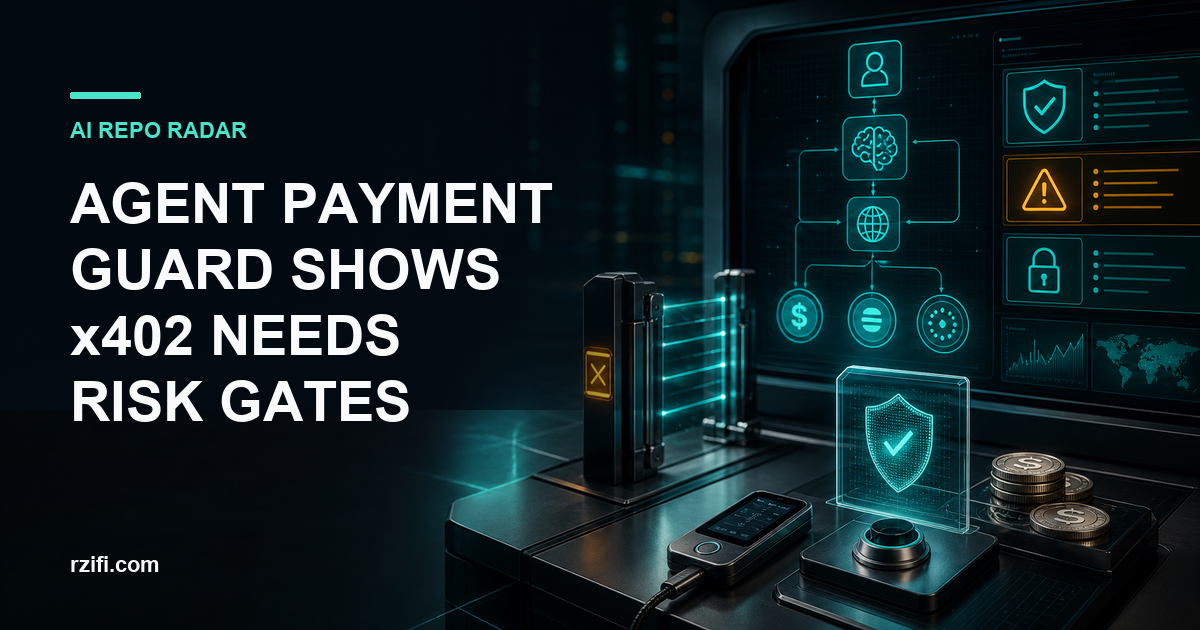

Building through similar complexity?
Discuss the operating decisions behind the essay, or explore where my experience can help.