Worldline's Digital Euro Pilot Needs Programme Gates
Worldline's selection for the Eurosystem digital euro pilot is a programme-management signal: the hard work is not announcing participation, but governing scope, merchant acceptance, offline flows, integration, evidence, and readiness across a regulated ecosystem.
In this essay
Digital euro headlines usually become policy arguments.
The better delivery question is more practical: what has to be true before a payment service provider can test a beta central-bank money product with merchants, central-bank staff, online journeys, point of sale, offline flows, and existing payment rails?
On 14 July 2026, the European Central Bank said it had selected 36 payment service providers from across the euro area for the digital euro pilot. The pilot is due to start in the second half of 2027 and run for 12 months. The ECB says the beta version will be technically and functionally close to the contemplated digital euro, but will not have legal tender status.
Worldline then confirmed its selection and said it will participate as both an acquiring payment service provider and a technical service provider, supporting infrastructure connectivity, transaction processing, banking channel integration, and merchant acceptance.
That is not a narrow test. It is a regulated ecosystem programme.
The Short Answer
A digital euro pilot needs programme gates before it needs scale ambition. The PMO should govern scope, role ownership, integration readiness, merchant acceptance, offline behavior, evidence, incident response, and exit criteria before the beta journey reaches real operational settings.
Without those gates, the pilot can create activity without learning.
The Role Map Is The First Gate
The ECB pilot has several moving parts. Some PSPs will distribute beta digital euro services to users. Some will serve selected merchants and enable them to receive beta digital euro payments. Some can play both roles.
Worldline's stated role spans acquiring and technical-service-provider capabilities. It also says it will work through its Luxembourg-based payment institution in cooperation with the Central Bank of Luxembourg, and through PAYONE in Germany and Austria.
That means the first programme gate is not technology. It is role clarity.
The PMO should be able to answer:
- which legal entity owns each pilot commitment;
- which countries and merchant segments are in scope;
- which parts of the journey are Worldline, bank, merchant, Eurosystem, or national-central-bank responsibilities;
- who owns acceptance defects, payment-state defects, offline defects, and customer-experience defects;
- which decisions need regulator, national central bank, merchant, bank, or internal approval.
If those answers are vague, the pilot will spend too much time routing accountability after incidents.
The Use Cases Are Operationally Different
The ECB says the pilot will test staff and merchant use cases including person-to-person payments, person-to-business payments, physical point of sale, Software Point of Sale, e-commerce, m-commerce, and online and offline situations.
Those are not variations of the same test case.
A cafeteria point-of-sale payment has different failure modes from an e-commerce checkout. Offline person-to-person payment has a different evidence problem from online wallet funding. Software Point of Sale has device, merchant, and security questions that do not exist in a hosted e-commerce page.
The PMO needs a separate readiness checklist for each journey.
For physical POS, I would gate terminal behavior, merchant receipts, reversal paths, offline fallback, staff training, and end-of-day reconciliation.
For e-commerce, I would gate checkout status, redirect or wallet return, failed-payment messaging, order release, refunds, reconciliation, and fraud-handling boundaries.
For offline use, I would gate value limits, device trust, double-spend controls, recovery when connectivity returns, and customer communication.
Bundling these into one "digital euro payment journey" hides the work.
A Pilot Needs Evidence, Not Only Feedback
Payments pilots often over-collect opinions and under-collect operating evidence.
User feedback matters. Merchant feedback matters. But the digital euro pilot should also produce hard records:
- payment attempt, authorization, completion, rejection, reversal, and refund states;
- latency and availability by journey;
- merchant acceptance errors by terminal, app, and integration path;
- offline transaction state before and after reconnect;
- support tickets and root causes;
- reconciliation breaks and aged exceptions;
- incident-response time;
- security, privacy, and access-control evidence;
- lessons that require rulebook, UX, API, or operating-model changes.
That is what makes the pilot useful for future issuance decisions.
Worldline's announcement says the company can connect the digital euro with existing rails, including instant payments, account-to-account solutions, cards, wallets, and domestic schemes. That is a real advantage only if the pilot evidence shows where orchestration helps and where it adds complexity.
The Dependency Gate Is Political And Technical
The ECB's digital euro pilot page says the ECB aims to be ready for potential first issuance during 2029, assuming the digital euro Regulation is adopted in 2026. It also says the Governing Council will only decide whether to issue once the Regulation is adopted.
That means the programme has a legislative dependency as well as a delivery dependency.
Good PMOs do not pretend that external dependency is controllable. They make it visible.
The pilot plan should separate what can be learned under a beta with no legal tender status from what can only be finalized after legislation and scheme decisions. For example, merchant pricing, liability, privacy obligations, access rules, offline limits, compensation, and dispute model may not all be fully fixed during the pilot.
The programme should mark those assumptions clearly so the pilot does not produce false confidence.
The Gate Stack I Would Use
For a PSP in Worldline's position, I would run eight gates.
Scope gate: countries, entities, merchants, journeys, channels, and user groups are documented.
Role gate: distributing, acquiring, technical service provider, bank, merchant, and central-bank responsibilities are assigned.
Integration gate: APIs, terminals, wallets, bank channels, monitoring, and test data are ready.
Acceptance gate: selected merchants can onboard, transact, refund, reconcile, and raise incidents.
Offline gate: offline value rules, device trust, reconnect behavior, and exception handling are proven.
Evidence gate: every material journey has logs, states, timestamps, owners, and decision records.
Incident gate: payment failure, privacy concern, security event, merchant outage, and customer complaint playbooks have been rehearsed.
Learning gate: the pilot has explicit hypotheses, success thresholds, stop conditions, and rulebook feedback paths.
That is how a pilot becomes a governance instrument instead of a showcase.
Why This Matters For Payment Leaders
The digital euro may or may not launch on the current political path. The operating lesson stands either way.
Any regulated payment pilot that touches merchants, wallets, banking channels, offline flows, and public infrastructure needs more than a backlog and a demo environment. It needs gates that make learning reliable.
For Rizwan's audience, the useful question is not "will the digital euro win?" It is whether the teams preparing for it can govern a multi-party payment pilot without losing the chain of evidence.
The decision test is simple: after a failed pilot payment, can the programme show who owned the journey, what state the payment reached, what the merchant saw, what the user saw, what evidence was retained, and which rule or product change follows?
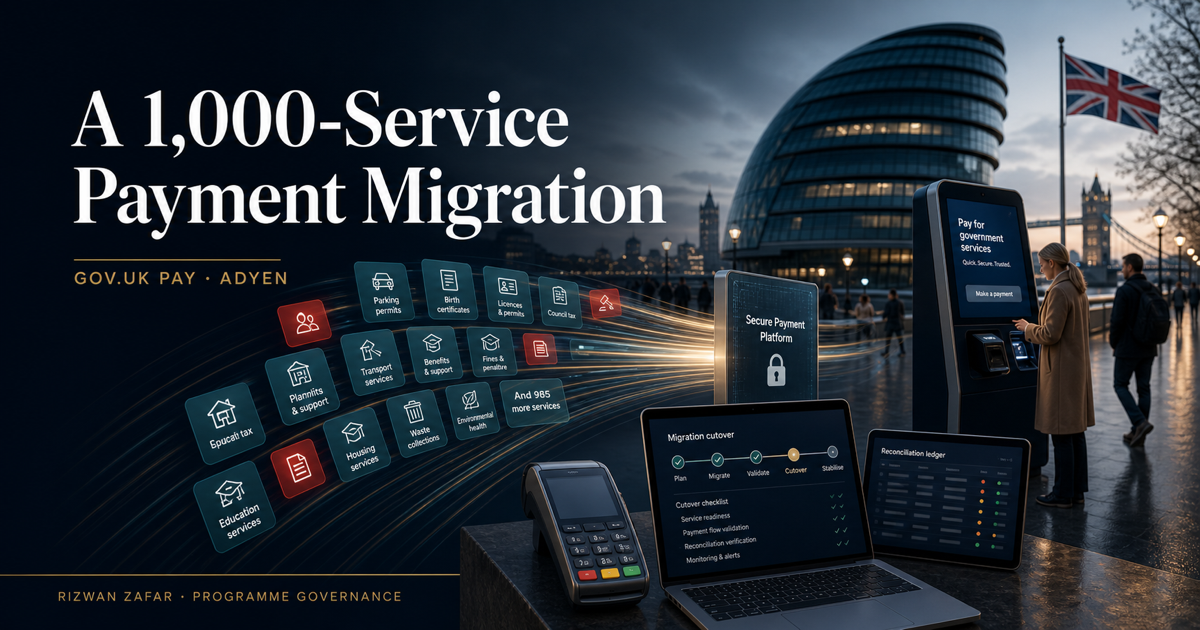
Relevant proof paths: regulatory programme management, GOV.UK Pay's 1,000-service migration, and vendor governance in fintech PMO. For help structuring high-stakes payment programmes, start at /contact/.
FAQ
When is the ECB digital euro pilot expected to start?
The ECB says the pilot is planned for the second half of 2027 and should run for 12 months.
Why does the pilot need programme gates?
The pilot spans PSP roles, merchants, central-bank participants, online and offline payments, technical infrastructure, evidence, and regulatory dependencies. Gates keep scope, ownership, and learning explicit.
Sources
Closing thought and further reading
Worldline's selection for the Eurosystem digital euro pilot is a programme-management signal: the hard work is not announcing participation, but governing scope, merchant acceptance, offline flows, integration, evidence, and readiness across a regulated ecosystem.
Ideas that continue the thread.
View all essays
Building through similar complexity?
Discuss the operating decisions behind the essay, or explore where my experience can help.