DeepMind's AI Control Roadmap Is a Programme Gate
DeepMind's AI Control Roadmap is a delivery-governance signal: AI-agent programmes need gates for monitored coverage, recall, response time, authority boundaries, drills, and escalation ownership.
In this essay
DeepMind's AI Control Roadmap is framed as AI security research.
Programme leaders should read it as a delivery gate.
In its June 2026 post on securing the future of AI agents, DeepMind says it developed an AI Control Roadmap for building and managing advanced AI deployed within Google. The post describes a defense-in-depth approach, building on the MITRE ATT&CK framework, and measures controls through coverage, recall, and time-to-response.
It also says DeepMind has analyzed one million coding-agent tasks to refine safety protocols and move beyond simple keyword filtering toward higher-signal behavioral patterns.
That is not only a research milestone. It is a programme-management lesson.
You cannot scale AI agents by shipping capability first and inventing controls later.
The Short Answer
AI-agent programmes need release gates based on control evidence, not only model capability. Before expanding scope, the programme owner should prove monitored coverage, detection recall, time-to-response, authority boundaries, drill results, and escalation ownership.
Without those gates, a successful pilot can become an uncontrolled production rollout.
Capability Is A Bad Go-Live Criterion
Most AI delivery plans still ask the wrong first question.
"Can the agent do the task?" is necessary, but it is not enough.
The better question is "Can the organisation control the agent when it does the wrong thing, tries the wrong action, receives the wrong context, or operates outside its approved authority?"
DeepMind's post is useful because it separates model behavior from system control. It describes threat taxonomies, monitoring, blocking actions before damage occurs, drills, and measurement. Those are programme artifacts.
A PMO can turn them into go-live gates.
The Gate Stack
For an AI-agent programme, I would not approve production expansion from a demo, benchmark, or executive sponsor alone.
I would require six gates.
Scope gate: the agent's approved task, user group, tool access, and decision authority are documented.
Coverage gate: the programme can show what fraction of relevant activity is monitored.
Recall gate: the team can show how many known bad or misaligned behaviors are caught in test and production-like runs.
Response gate: the team can show how quickly detection becomes intervention, escalation, or rollback.
Authority gate: risky actions are read-only, draft-only, approval-required, or blocked, with named owners.
Drill gate: the team has run adversarial or failure drills and logged the findings.
That is not bureaucracy. It is the minimum evidence set for a system that can act.
Why MITRE Matters To Delivery
MITRE ATT&CK is useful to programme teams because it turns vague threat language into a shared taxonomy. DeepMind explicitly points to MITRE's approach for breaking potential attacks into smaller tactics and techniques.
That helps delivery because teams can plan against named failure modes instead of debating abstract risk.
For example, a fintech AI-agent rollout might define patterns such as:
- hidden instruction changes in partner messages;
- attempted access to merchant PII beyond approved scope;
- unauthorized refund or payout tool use;
- risky policy advice in customer support;
- suspicious escalation suppression;
- repeated action attempts after a denial.
Each pattern can have an owner, detection method, test case, alert route, and rollback condition.
That is how risk becomes deliverable.
The Programme Board Needs Control Metrics
Most steering committees ask for delivery milestones, spend, blockers, and business value. For AI agents, they need control metrics beside those.
The recurring board pack should show:
- approved agent scope by workflow;
- tool permissions by action type;
- monitored coverage;
- detection recall on the latest eval set;
- time-to-response for critical events;
- unresolved high-risk findings;
- manual approval volume;
- production incidents and near misses;
- rollback or pause decisions;
- customer or operational impact from agent actions.
Those metrics make programme status harder to dress up.
An agent may be valuable and still not ready for a wider rollout. A model may improve and still fail the authority gate. A support workflow may reduce queue load and still require rollback if policy violations rise.
That is the point of gates.
Where Fintech Teams Should Start
Payments and fintech teams should start with workflows where action authority can be constrained.
Good first candidates include incident summarization, merchant-support drafting, reconciliation-exception clustering, document completeness checks, policy Q&A for internal staff, and runbook matching.
Riskier candidates include releasing funds, changing limits, approving merchants, modifying fraud thresholds, issuing refunds, or handling regulated complaints end to end.
Those actions are not impossible forever. They just require stronger gates.
The programme plan should move through phases: read-only recommendation, draft with approval, narrow tool use, and only then bounded automation. Each phase needs pass/fail criteria before the next one starts.
That sequencing is the difference between innovation theatre and accountable delivery.
The Real Programme Decision
The decision is not whether AI agents are useful. They are.
The decision is whether the organisation can expand authority at the same pace as control evidence.
DeepMind's roadmap gives programme leaders a practical vocabulary: coverage, recall, response, threat taxonomy, monitoring, and drills. Those terms belong in the steering committee, not only in the security research team.
For Rizwan's audience, the lesson is direct. A payments or fintech AI programme should not ask for production scale until control metrics are in the same pack as value metrics.
The decision test is simple: if the agent made a harmful recommendation today, could the programme owner prove where it was monitored, whether it was caught, who responded, how fast they acted, and what changed before the next release?
Relevant proof paths: AI adoption delivery governance, RAID and steerco discipline, and Rizwan's transformation programme work. For programme governance help, start at /contact/.
Closing thought and further reading
DeepMind's AI Control Roadmap is a delivery-governance signal: AI-agent programmes need gates for monitored coverage, recall, response time, authority boundaries, drills, and escalation ownership.
Ideas that continue the thread.
View all essays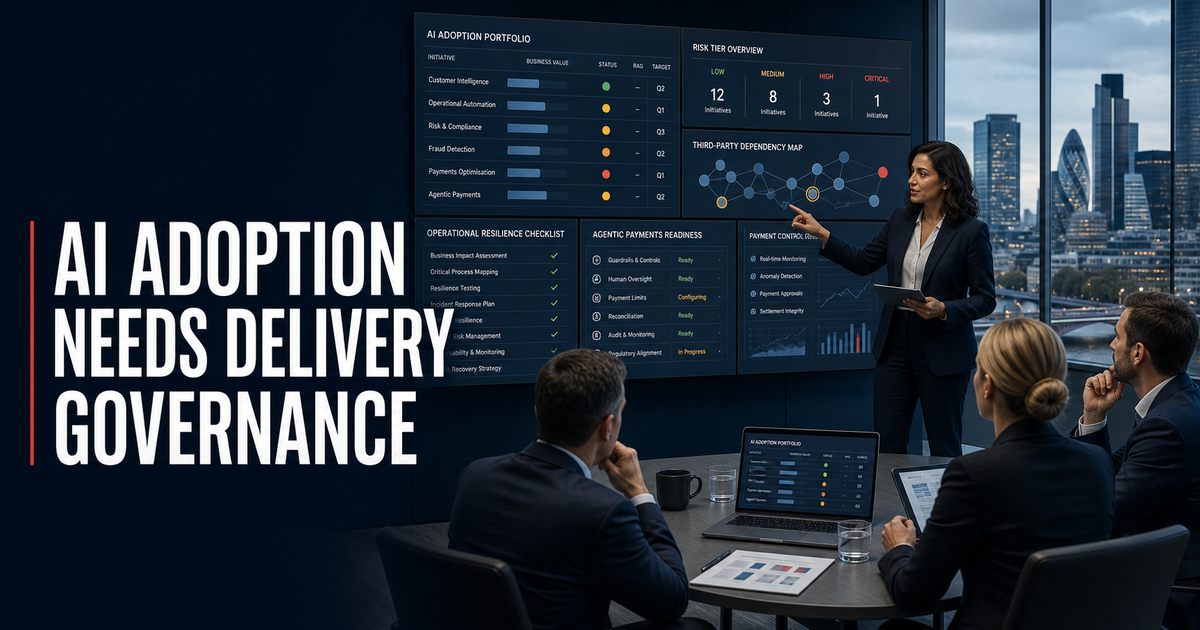
Building through similar complexity?
Discuss the operating decisions behind the essay, or explore where my experience can help.