What does an acquirer's merchant support operation do?
A merchant sees one support number. Behind it, an acquirer runs onboarding, terminal, settlement, dispute and risk teams that each own a different part of the same payment.
In this essay
An acquirer's merchant support operation keeps merchants able to accept cards and get paid. It verifies and onboards businesses, deploys and manages payment terminals, answers settlement and reconciliation questions, processes chargebacks, monitors merchants against Visa and Mastercard risk programs, and routes every merchant query to the team that can resolve it within an agreed service level. The merchant sees one support line; behind it sit several teams that each own a different part of the same payment.
If you are new to the acquirer's role itself, start with what merchant acquiring is and how it works. This article covers what happens after the contract is signed.
Which teams sit behind merchant support, and how is a query routed?
Most acquirers organize merchant operations around five specialist functions plus a frontline: onboarding and KYB, terminal operations, settlement and reconciliation, disputes, and risk monitoring. The frontline's job is to identify the merchant, classify the problem and hand it to the right owner with enough evidence that the merchant does not have to repeat the story.
By phone, portal, email or terminal helpdesk, quoting the merchant ID.
The agent checks known incidents, sets severity and classifies the query.
Traces the batch, deductions and bank credit.
Checks the device in the TMS, pushes a fix or swaps it.
Collects evidence and responds before the network deadline.
Explains the review, requests documents and decides on release.
The merchant gets an answer; the root cause is tagged for reporting.
Simplified: real queues add regulatory complaint handling and hand-offs to processors, gateways or the card networks.
How does merchant onboarding and KYB work at an acquirer?
Onboarding is where the acquirer decides how much risk it is taking. Know-your-business (KYB) checks confirm the legal entity, its owners and directors, the business model, the website or premises, the merchant category, expected volumes and how long the merchant takes to deliver what it sells.
Two scheme-driven checks sit inside that process. First, Mastercard describes MATCH Pro as mandatory for its acquirers: before signing a merchant they query it to see whether another acquirer terminated that merchant, and when they terminate a merchant for a listed reason they must add a record. Mastercard Developers: MATCH Pro Second, third parties in the chain must be registered by the acquirer. Mastercard requires an acquirer to register a payment facilitator before it operates Mastercard: payment facilitators, and Visa's Third Party Agent program puts registration of ISOs and similar agents on the acquirer. Visa: Third Party Agent registration FAQ
The operations problem is speed without blind spots: KYB automation without blowing up risk covers where automation helps and where a human queue is still needed.
What is a terminal management system (TMS)?
A terminal management system is the software an acquirer or terminal provider uses to register payment devices, push software and configuration to them remotely, and monitor whether they are online. Configuration typically includes the merchant and terminal IDs, which card brands and entry modes are enabled, receipt text and host connection details. Without a TMS, every change means a site visit or a device swap.
Terminal operations also covers logistics: shipping, activation, replacement of faulty units, retrieval when a merchant leaves, and keeping an inventory that matches what the TMS shows.
Device approval matters too. The PCI Security Standards Council lists approved PIN transaction security (PTS) point-of-interaction devices, with an expiry date on each approval, and encourages merchants and acquirers to use that listing when selecting devices. PCI SSC: PTS POI Some markets add local certification: in Saudi Arabia, a SAMA circular requires point-of-sale devices to receive technical approval from the Saudi Payments authorization center, which also confirms compatibility with the mada network. SAMA Rulebook: upgrading point-of-sale devices to 4G
How are settlement and reconciliation queries handled?
Questions such as "where is my money?" and "why is this payout short?" belong to the settlement team. It answers them by tracing a bank credit back to the batch and the transactions in it, then explaining every deduction: fees, refunds, chargebacks, reserve holdbacks and adjustments, plus delays from cut-off times and bank holidays.
The fix is mostly upstream: statements that carry batch references, payout reports that show gross, deductions and net, and a published settlement schedule. Settlement windows and merchant trust covers what to promise merchants about timing.
How does an acquirer handle chargebacks?
When a cardholder disputes a payment, the issuer raises a chargeback through the network to the acquirer. The acquirer's dispute team usually debits the merchant, notifies it, collects evidence and, where the evidence supports it, submits a response within the network's time limits. Each network publishes its own rules; Mastercard's are in its Chargeback Guide. Mastercard: Chargeback Guide, Merchant Edition
The operational risk is missed deadlines and weak evidence. The card dispute lifecycle sets out a network-neutral process from evidence capture to feedback.
How do Visa and Mastercard monitoring programs affect merchants?
Both networks run programs that measure fraud and disputes and hold the acquirer responsible for problem merchants.
- Visa Acquirer Monitoring Program (VAMP). Visa's 2025 fact sheet says it consolidated its earlier acquirer, fraud and dispute monitoring programs into a single global program built around a count-based VAMP ratio that combines fraud and disputes on card-not-present transactions. Visa: VAMP fact sheet 2025
- Mastercard Excessive Chargeback Program (ECP). Mastercard lists ECP among its customer compliance programs. It classifies merchants as Excessive Chargeback Merchants or High Excessive Chargeback Merchants against chargeback thresholds and alerts the acquirer, which is expected to work with the merchant on remediation. Mastercard: rules for merchants
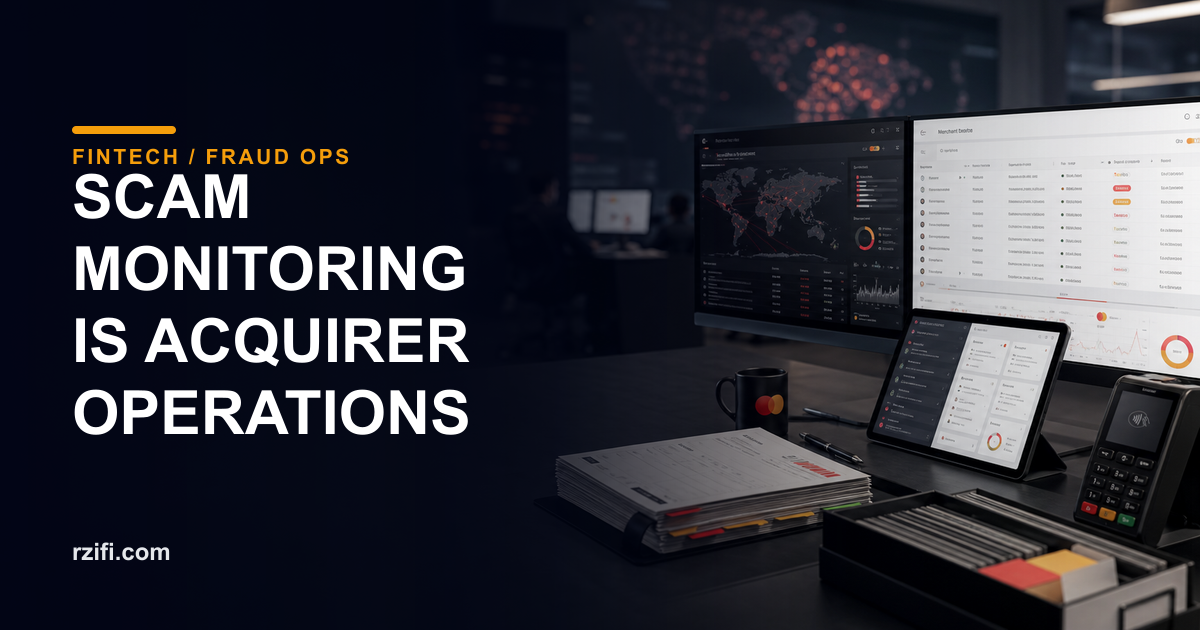
Thresholds, fees and timelines change, so the risk team should work from the current program documents, not a vendor summary. In practice the team tracks each merchant's ratios monthly, warns merchants before they cross a threshold, agrees remediation plans and, if needed, terminates. Mastercard's newer scam rules extend the same logic; see Mastercard's scam-merchant monitoring.
What SLAs and escalation paths should merchant support have?
A service level agreement needs three things defined before any number is attached: what counts as first response, what counts as resolution, and which severity tier a case belongs to. A workable tiering, before targets are set, is:
- Severity 1: the merchant cannot accept payments at all.
- Severity 2: acceptance is degraded, for example one channel or one card brand failing.
- Severity 3: money questions, such as a missing or short payout.
- Severity 4: information requests and configuration changes.
Escalation paths should name the owner at each step, including when a case goes to the processor, the gateway or a card network. Set targets from your own baseline and contracts rather than borrowed benchmarks, and review breaches by root cause, not by agent.
Operational KPI checklist
| KPI | Definition |
|---|---|
| Time to activate | Time from complete application to the merchant's first approved transaction |
| Onboarding approval rate | Approved applications divided by complete applications in the period |
| First-contact resolution | Cases resolved without hand-off or reopening, divided by all cases |
| Time to first response | Time from case creation to first substantive reply, by severity |
| Time to resolution | Time from case creation to confirmed resolution, by severity |
| Terminal check-in rate | Deployed terminals that reported to the TMS in the period, divided by all deployed terminals |
| Settlement query rate | Payout and fee queries per 1,000 active merchants in the period |
| Chargeback ratio | Chargebacks divided by transactions, using each network's own definition and period |
| Dispute win rate | Disputes won after response, divided by disputes responded to |
| Merchants in monitoring | Count of merchants identified in Visa or Mastercard monitoring programs |
| Escalation rate | Cases escalated beyond the owning team, divided by all cases |
FAQ
What does acquirer merchant support handle?
Onboarding, terminal issues, payout and fee questions, chargebacks and risk holds. A frontline team triages and routes each case to the specialist team that owns it.
What is a TMS in payments?
A terminal management system is software that registers payment terminals, pushes software and configuration to them remotely and reports whether they are online.
Why did my acquirer ask for documents after I was approved?
Acquirers keep monitoring merchants after onboarding. A change in volume, refunds or chargebacks, or a scheme monitoring alert, can trigger a review and a document request.
What happens if a merchant enters a Visa or Mastercard monitoring program?
The network holds the acquirer responsible, and the acquirer usually requires a remediation plan. Persistent problems can lead to fees passed on to the merchant or termination.
Which KPIs should an acquirer's merchant operations track?
Start with time to activate, first-contact resolution, time to resolution by severity, terminal check-in rate, settlement query rate, chargeback ratio and dispute win rate, each with a written definition.
Closing thought and further reading
A merchant sees one support number. Behind it, an acquirer runs onboarding, terminal, settlement, dispute and risk teams that each own a different part of the same payment.
Ideas that continue the thread.
View all essays
Need help applying this to your business?
Explore practical support for payment operations, product decisions, program delivery and AI automation, grounded in the challenges behind this essay.