ISO 8583 Payment Message Lifecycle
ISO 8583 gives card participants a common message interface. The network profile and acquirer contract determine the fields, code meanings, timing, and recovery behavior your integration must implement.
In this essay
An ISO 8583 authorization is a request-and-response exchange between card-payment participants. To operate it safely, a team needs more than a table of response codes: it needs to know which party sent each message, which network profile defines the fields, how the response maps to the merchant API, and what to do when the reply is late or missing.
The practical rule: treat ISO 8583 as a message framework, not a universal integration recipe. ISO describes the interchange interface and message structure; the applicable card-scheme, processor, or domestic-switch profile supplies the field definitions, code sets, transport rules, and operational timings. Confirm that profile before writing parsers or retry policy. ISO 8583:2023 scope
The authorization path
In a typical card-not-present purchase, the merchant or payment service provider submits an authorization through an acquirer or processor. It routes through the relevant network to the issuer or its processor, where account, transaction, and risk signals are evaluated. A response returns along the route. The merchant API may normalize that outcome while operational records retain network details.
Do not infer the route from the word “ISO.” The acquirer may hide network messages behind a REST API, and the gateway may normalize raw responses. Visa Pay documents a callback with reduced authorization data plus ISO-message fields in original_network_data; that is its own integration contract. Visa Pay authorization endpoints
A working trace should connect the order and payment attempt to provider references, available network identifiers, timestamps, decision source, and resulting state. Visa Pay documents callback fields including MTI, response code, authorization code, retrieval reference number, and transaction identifier; field availability and encoding depend on the profile. Visa Pay callback fields
MTI, bitmap and data elements
Three pieces help you read a decoded message. The message type indicator (MTI) identifies its purpose. A bitmap indicates which data elements follow. The data elements carry the values defined by the connection’s profile. Encoding and length rules still come from the agreed packager: a readable field dump is not the wire payload. The jPOS documentation explains the field-presence bitmap and why its packing configuration matters. jPOS bitmap guide
For orientation, common 1987-style MTIs include these pairs. They are examples, not a certification specification. Moov’s implementation documentation lists these message families; later editions and network profiles can differ. Moov MTI reference
| Example request or advice | Example response | Purpose |
|---|---|---|
0100 |
0110 |
Authorization request and response |
0200 |
0210 |
Financial transaction request and response |
0420 |
0430 |
Reversal advice and response |
0800 |
0810 |
Network-management request and response |
A product specification should explain how each supported message changes the payment state. A response to a network-management message does not establish that a customer payment succeeded. Likewise, record network correlation identifiers separately from the merchant’s order and API idempotency key; they serve different joins and retention windows.
What to inspect in a message
Use profile documentation and a provider-approved sample to establish:
- how the message type is represented and which request/response or follow-up messages the integration uses;
- which data elements are mandatory, conditional, or scheme-specific;
- how amounts and currencies are encoded, including scale and exponent handling;
- what identifiers correlate the request, response, reversal, clearing record, and merchant order;
- which security-sensitive elements must be masked, encrypted, or excluded from ordinary logs;
- the transport framing, timeout, duplicate-detection, and connection-recovery rules.
The ISO standard's scope explicitly excludes the transport method and settlement. A message can therefore be correctly assembled while the TCP framing, connection management, or downstream settlement process is wrong. Keep those contracts separate in design and testing. ISO 8583:2023 scope
Do not rely on an internet “field map” as the sole specification. Field numbering and interpretation can vary between editions and network profiles. Use the profile bound to the live connection.
Normalize without losing the evidence
A merchant API usually needs a compact response model: approved, refused, pending/unknown, or technical error. Preserve the provider or network response alongside that normalized outcome, with access controls and retention appropriate to the data. Keep the original response code as a string: Visa Pay says its code is two characters and documents both numeric and alphanumeric values such as N0; coercing it to an integer would destroy information. Visa Pay response codes
Keep the raw reason internal. Adyen notes that raw acquirer responses differ by scheme and can change, maps them to its own result and refusal-reason fields, and advises against exposing raw responses to shoppers. That distinction supports a safer pattern: preserve raw evidence for authorized operations teams, map it to a stable internal category, and give customers a clear action without exposing issuer or anti-abuse details. Adyen response handling · Adyen raw responses
A useful internal mapping separates these cases:
| Internal outcome | Operator meaning | Customer handling |
|---|---|---|
| Approved | Issuer/network approved the request | Continue the documented capture and fulfillment flow. |
| Issuer refusal | A definitive response says the request was not approved | Explain that the bank did not approve it; offer an allowed alternative. |
| Invalid request/configuration | The message or merchant setup needs correction | Do not retry unchanged; route to integration support. |
| Timeout/unknown | No reliable response was received | Check the original attempt before creating another one. |
| Duplicate/reversal-related | A repeat or corrective message needs reconciliation | Correlate with the original attempt and follow the profile's procedure. |
This is an application-level design aid, not a network code mapping. A visible code can be qualified by scheme, process code, or message type. Visa's reference, for example, ties code 85 to a specific card-account-verification process. Visa request and response codes
A response is not the same as HTTP success
A successful HTTP response from a gateway can contain a refused authorization. Adyen distinguishes successful API submission from the financial institution's decision. Model API success separately from authorization, capture, and settlement. Adyen response handling
If a request times out, the issuer may still have approved it. The outcome stays unknown until the original attempt is resolved. Connect the messaging workflow to inquiry, asynchronous updates, and idempotency; do not create a new authorization just because the caller's socket closed.
Some profiles support a reversal or other follow-up message to correct an authorization that cannot be completed as intended. Whether to send one, which fields to carry, and how long to wait are profile-specific. Build reversal handling from the acquirer/network procedure and test it against real sandbox or certification behavior; do not invent a generic retry loop.
ISO 8583 authorization and timeout trace
Illustrative operating trace, not a wire-format sample. Message types, timing and recovery behavior must come from the agreed profile.
- Store the merchant order, payment attempt and correlation references before submission.
- Submit the authorization using the acquirer’s supported message or API contract and preserve the returned provider reference.
- Record an approval separately from capture and settlement. If the reply is missing, keep the outcome unknown rather than inventing a refusal.
- Resolve the original through the supported inquiry or reversal procedure before deciding whether another attempt is safe. Attach the late response or corrective message to that same history.
Visa Pay says a client should answer its authorization callback within three seconds to avoid timeout and automatic decline, and recommends 800–1,000 ms for most clients. These figures apply to that product, not all ISO 8583 connections. Visa Pay authorization endpoints
Implementation and certification checklist
Before production, record and verify:
- Profile ownership: the exact network, processor, message profile, edition, and contacts who approve changes.
- Parser contract: encoding, length/framing, required fields, optional fields, and malformed-message behavior.
- Outcome mapping: approved, refused, timeout, duplicate, reversal, and technical-error handling for the specific code table.
- Correlation: how each request is joined to response, later clearing, inquiry, or correction without relying on timestamps alone.
- Retry safety: which failures can be retried, how the original result is checked first, and how duplicate attempts are prevented.
- Data controls: masking, storage, access, and safe diagnostics for cardholder and authentication data.
- Operational tests: delayed response, duplicate message, issuer unavailable, malformed field, late response, and restart during an in-flight request.
- Reconciliation: how authorization, capture, reversal, and settlement discrepancies become owned exceptions.
Limitations
ISO 8583 knowledge does not replace scheme rules, processor certification, or a contractual message specification. The public ISO page identifies the standard's purpose and limits, but the detailed maintained field and value definitions are supplied by its maintenance agency and network-specific materials. ISO 8583:2023
FAQ
Is ISO 8583 the same as the merchant's payment API?
No. A processor can expose REST or another interface and translate to network messages internally. The API's status model and the underlying network response are related but not interchangeable.
Does response code 00 always mean the order is paid?
No. Interpret the code in the context of the message type and network profile. An authorization approval alone does not establish capture, settlement or merchant funding. Follow the processor’s documented lifecycle.
Can we retry after a timeout?
Not blindly. Resolve the original attempt with the provider's supported inquiry or recovery mechanism and apply its retry contract. See payment timeouts and idempotency.
Should raw response text appear in checkout?
Usually no. Keep it in controlled operational records and present a stable customer message with an appropriate next step, following the acquirer and scheme rules.
Closing thought and further reading
ISO 8583 gives card participants a common message interface. The network profile and acquirer contract determine the fields, code meanings, timing, and recovery behavior your integration must implement.
Ideas that continue the thread.
View all essays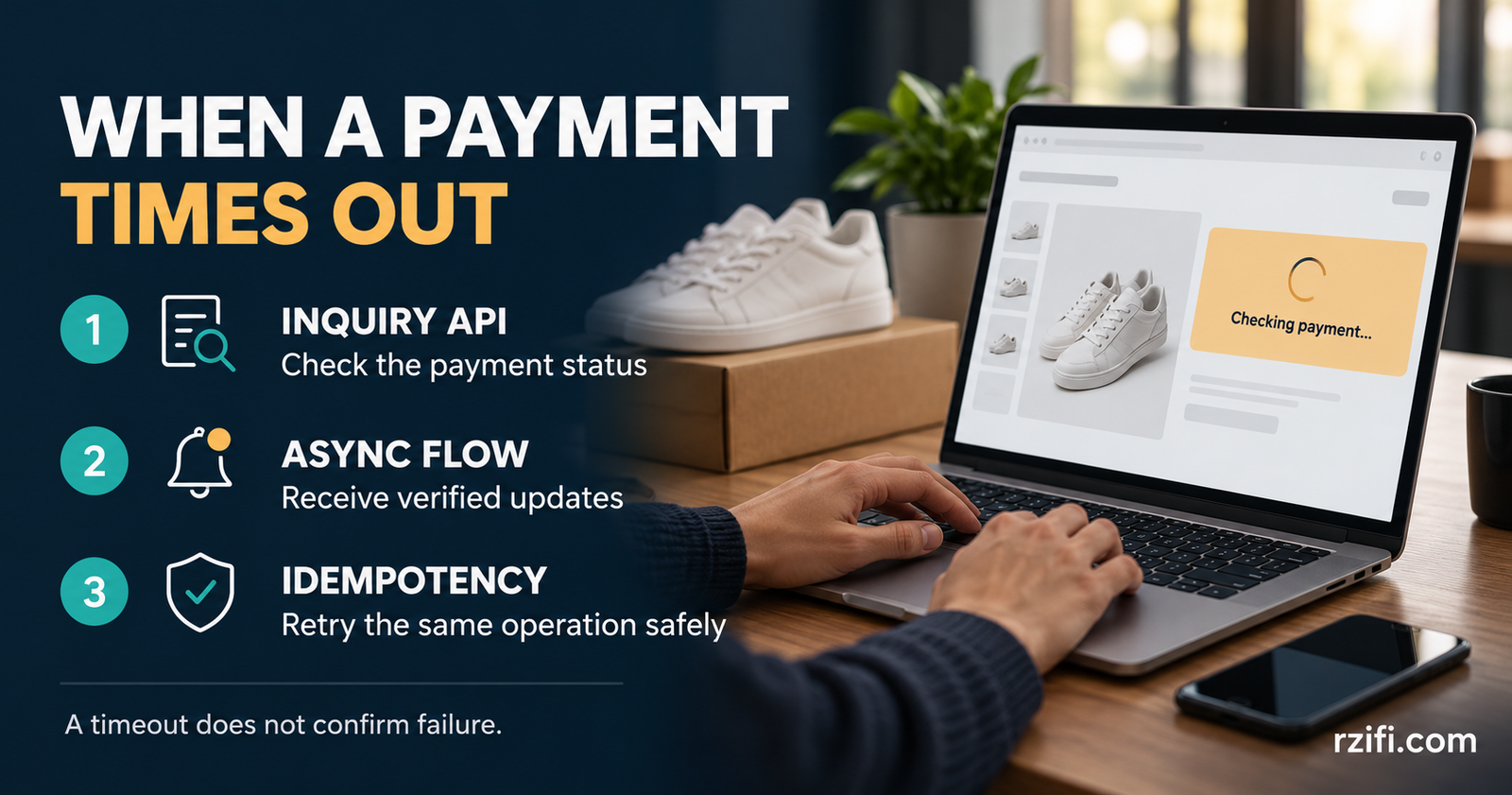

Need help applying this to your business?
Explore practical support for payment operations, product decisions, program delivery and AI automation, grounded in the challenges behind this essay.