In this essay
The useful AI infrastructure question is not "cloud or local?"
The better question is "which workload deserves which control surface?"
KTransformers, from kvcache-ai, is an open-source research project focused on efficient inference and fine-tuning for large language models through CPU-GPU heterogeneous computing. Its README now presents two user-facing paths from the kt-kernel source tree: inference and supervised fine-tuning.
That makes it a good repo-radar signal for fintech and product leaders.
Not because every regulated team should suddenly run large MoE models on local hardware. Most should not. The signal is that local and hybrid inference are becoming practical enough to deserve a real operating scorecard rather than a reflexive "hosted API only" or "self-host everything" debate.
The Short Answer
Local AI infrastructure is not automatically cheaper, safer, or more private. It becomes useful when the team can prove workload fit, latency, utilization, model quality, governance, patching, and supportability against hosted alternatives.
That is where the product decision starts.
What Changed In The Repo
KTransformers has been active through 2026. The README lists June updates for MiniMax-M3 and GLM-5.2 support, and an April update that split the project into clearer inference and SFT entry points.
The latest listed release, v0.6.3, was published on 21 June 2026 and adds day-zero support for two large mixture-of-experts models, plus an end-to-end LoRA serving path for Qwen3.5 MoE. The prior v0.6.1 release notes describe a major refactor of the fine-tuning path around kt-kernel, package installation for ktransformers[sft], and benchmarked performance gains in a specific setup.
The exact benchmark numbers should be treated carefully because model, hardware, context length, LoRA setup, and baseline choices matter. The operator signal is broader: open-source AI infrastructure is moving toward more specialized hardware-aware paths, not just generic model wrappers.
Why A Fintech Leader Should Care
Payments and fintech teams usually care about four constraints:
- cost per useful task;
- latency under operational load;
- data handling and privacy;
- auditability and support.
Hosted models are still the right answer for many product surfaces. They reduce infrastructure burden, simplify upgrades, and give teams access to frontier quality. But some workloads do not need frontier reasoning. They need predictable extraction, classification, summarization, routing, matching, or support assistance at high volume and known quality thresholds.
Those are the workloads where local or hybrid inference can become interesting.
Examples:
- merchant integration ticket classification;
- dispute evidence summarization;
- sanctions or adverse-media triage support, with human review;
- payment operations incident clustering;
- internal knowledge retrieval and answer drafting;
- low-risk reconciliation narrative generation.
None of these should be handed to a model without controls. But they may not require a premium hosted model on every call.
The Cost Trap
Local inference can look cheap in a spreadsheet and expensive in production.
A serious comparison must include:
- hardware acquisition or rental;
- GPU and CPU utilization;
- engineering time for builds, drivers, kernels, and model compatibility;
- monitoring, queueing, autoscaling, and incident response;
- security patching and dependency risk;
- quality regressions when models or kernels change;
- fallback to hosted models when local paths fail;
- energy, capacity planning, and support overhead.
The right question is not "what is the token price?" It is "what is the fully loaded cost per accepted business outcome?"
If a local model reduces unit cost but increases false positives in fraud triage, the saving is fake. If it lowers latency for a high-volume support flow with stable quality, it may be a real advantage.
The Governance Trap
Local does not automatically mean governed.
A model running inside your infrastructure can still leak data into logs, produce unreviewed decisions, operate on stale weights, call unsafe tools, or drift under poorly tested fine-tunes. A local stack needs the same product controls as a hosted one:
- approved use cases and forbidden actions;
- model and checkpoint inventory;
- evaluation sets tied to real business errors;
- prompt and fine-tune versioning;
- access control by data class;
- trace retention and deletion policy;
- incident rollback;
- human review thresholds;
- evidence for auditors and risk owners.
For regulated work, "we self-hosted it" is not an audit answer. It is only a deployment detail.
The Scorecard I Would Use
If a fintech team wanted to test KTransformers or any similar local inference stack, I would not begin with a platform migration.
I would run a narrow bake-off:
- one bounded workflow with existing human labels;
- hosted baseline, local baseline, and hybrid fallback;
- identical input set and output rubric;
- latency by percentile, not average only;
- cost per accepted output after human review;
- hallucination, omission, and policy-violation rate;
- operational toil per week;
- rollback time when a model or dependency breaks;
- security review of data paths, logs, and credential scope.
Then I would decide whether local inference earns a production path.
Operator Takeaway
KTransformers is not a magic answer for regulated AI. It is a reminder that model operations are becoming more modular, hardware-aware, and workload-specific.
That should make product leaders more disciplined, not more excited.
The debate point: which of your AI workloads are expensive because they need frontier reasoning, and which are expensive because you have not measured the cheaper control surface yet?
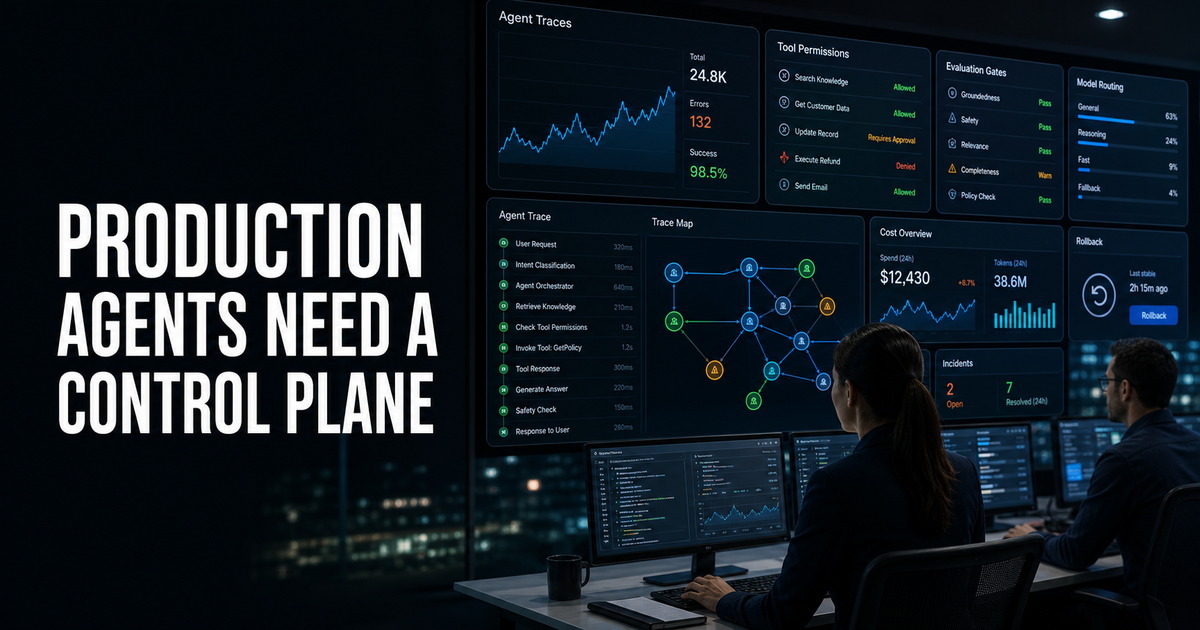
Talk to me about AI operating models for fintech teams or review related work on agent harness evaluations, production agent control planes, and payment problems where ML beats LLMs.
FAQ
Should every fintech run local LLM inference?
No. Local inference is useful only when a bounded workload can beat hosted alternatives on cost, latency, control, and supportability without weakening governance.
What is the safest first test?
Pick one internal workflow with existing human labels, run hosted and local baselines against the same inputs, and compare accepted-output cost, latency, and review failures.
Does self-hosting solve AI privacy risk?
No. It changes the control surface. The team still needs logging, access control, patching, model provenance, data retention rules, and human review where decisions are sensitive.
Closing thought and further reading
The repo-radar lesson is not that every fintech should run large models locally. It is that local inference is becoming a serious option that needs an operating scorecard.
Ideas that continue the thread.
View all essays
Need help applying this to your business?
Explore practical support for payment operations, product decisions, program delivery and AI automation, grounded in the challenges behind this essay.