How card acceptance works in the UAE: a merchant guide
UAE card acceptance now has three layers: international schemes, the new Jaywan national scheme and Aani instant payments. Each one changes what you should ask an acquirer.
In this essay
In the UAE, merchants accept cards through an acquirer or payment service provider licensed by the Central Bank of the UAE (CBUAE), which treats merchant acquiring and payment aggregation as regulated retail payment services. Customers pay with international scheme cards and, since phased issuance began in July 2026, with Jaywan, the UAE's national card scheme. Aani, the national instant payment platform, adds QR and request-to-pay options beside cards. A merchant's main decisions are which licensed provider to use and whether it supports Jaywan, wallets and local settlement.
This guide covers who may acquire, what Jaywan and Aani change, how wallets fit, and what a foreign merchant should check. For the underlying roles, start with what merchant acquiring is.
Who is allowed to acquire card payments in the UAE?
The CBUAE licensing page lists Stored Value Facilities and Retail Payment Services among its regulated license types. Retail payment services cover activities such as payment account issuance, payment instrument issuance, merchant acquiring, payment aggregation, domestic and cross-border fund transfers, payment token services, payment initiation and account information. CBUAE: licensing
Supervision is active, not only a licensing step. In May 2026 the CBUAE published an AML/CFT thematic review of providers of stored value facilities, retail payment services and card schemes, and payment token services. CBUAE: thematic review of SVF, retail payment services and card schemes, and payment token providers CBUAE makes payment controls a launch gate summarizes what it found.
License categories matter to merchants because they shape who controls settlement. Adyen, for example, announced in June 2026 that it had obtained a Retail Payment Services Category II license from the CBUAE, saying the license gives it full control over local settlements without reliance on third parties. Adyen: UAE Central Bank licenses Adyen Adyen's UAE license and local settlement explains why that matters operationally.
The specific license categories and conditions are set in CBUAE regulation, so read the current text rather than a summary. Then ask any provider three things: which legal entity holds the license, which activities it covers, and which entity actually settles your funds. If the provider is licensed in a financial free zone rather than by the CBUAE, ask what that license covers for onshore merchants.
What is Jaywan, and what does it change for merchants?
Jaywan is the UAE's first national card scheme. On 20 July 2026 the CBUAE said nationwide Jaywan card issuance had begun in phases through banks, licensed financial institutions and exchange houses, and that Jaywan cards are accepted at point-of-sale terminals, e-commerce platforms, ATMs and digital wallets, for domestic and international transactions under applicable rules. CBUAE: Mansour bin Zayed inaugurates Jaywan
Al Etihad Payments, which lists Jaywan among its services, describes it as the UAE's national card payment scheme and emphasizes localizing debit and prepaid card transactions, with data processed and stored in the UAE. Al Etihad Payments: about Jaywan Its explainer lists partnerships with Visa, Mastercard, Discover and UnionPay. Al Etihad Payments: Jaywan questions answered
Two card types follow from that:
- Co-badged Jaywan cards, such as the Jaywan and Mastercard debit and prepaid cards announced by Al Etihad Payments. Al Etihad Payments: Jaywan-Mastercard co-badged cards
- Mono-badged Jaywan cards, for which Al Etihad Payments and UnionPay International signed an MoU to enable global acceptance through the UnionPay network. Al Etihad Payments: UnionPay MoU
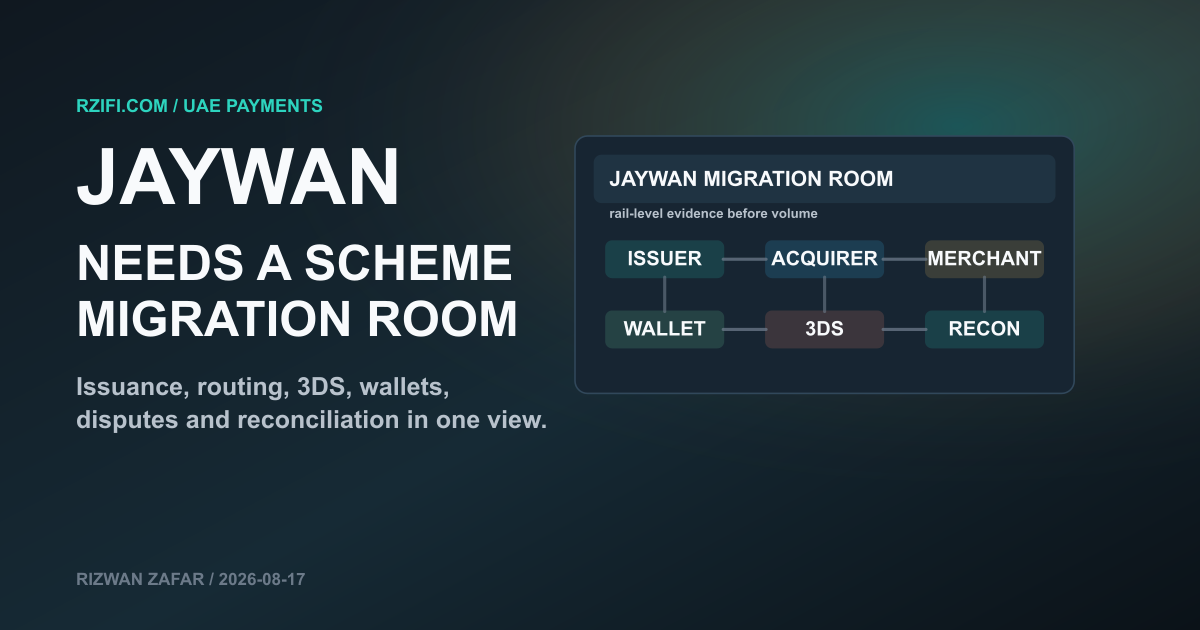
For a merchant, the practical point is that a co-badged Jaywan card can arrive on either network, while a mono-badged card needs Jaywan acceptance or an enabled partner route. Acquirers are adding support channel by channel; Network International, for example, announced Jaywan acceptance for online payments. Network International: Jaywan online acceptance Ask your provider which channels accept Jaywan today, how co-badged cards are routed, and whether reports show the network per transaction. The Jaywan scheme-migration control room covers the operating risks.
How does Aani fit alongside cards?
Aani is not a card scheme. Al Etihad Payments presents it as the UAE's national instant payment platform, with proxy payments, QR-code payments and Request to Pay. For small merchants and sole proprietors, its help material describes customers scanning a static or dynamic QR code, accepting a request in the Aani app, or paying to a merchant tag. Al Etihad Payments: Aani, Al Etihad Payments: Aani help
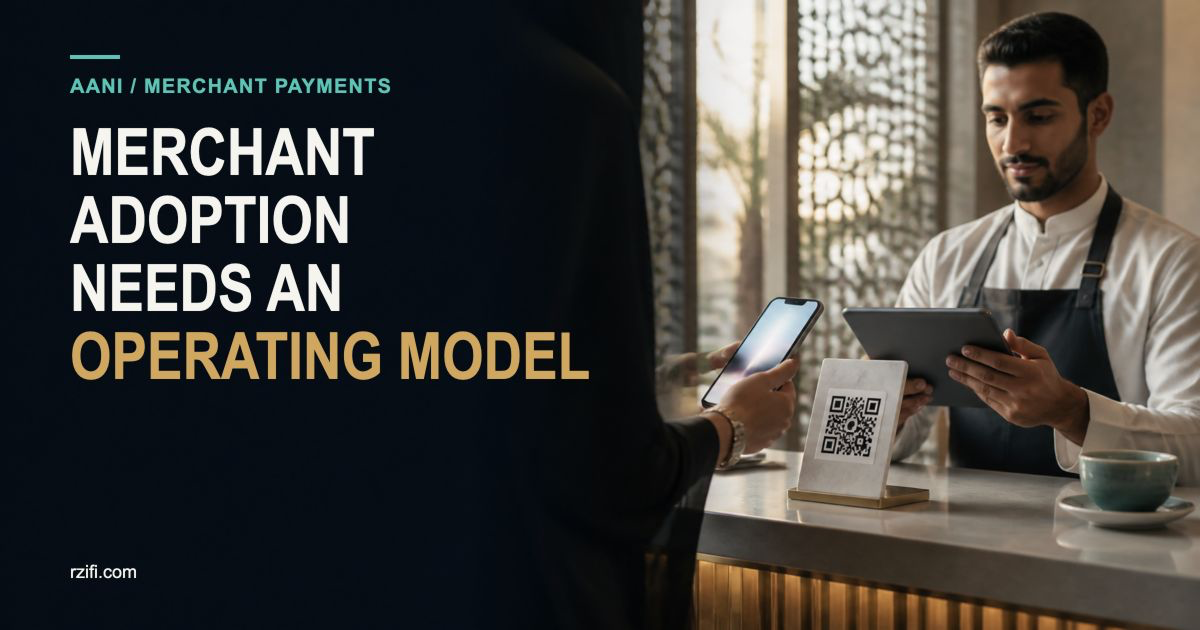
Because Aani moves money account to account, refunds, confirmations and reconciliation work differently from card payments. Treat it as a separate payment method with its own exception process, not as another card brand. Aani's merchant adoption problem goes through what to measure.
How do digital wallets work for UAE card acceptance?
Wallets carry the same cards in tokenized form, so the questions are about which networks the wallet presents. The CBUAE lists digital wallets among the places Jaywan cards are accepted. On the Apple side, PassKit includes a Jaywan payment network type, available from iOS 18.4, so an app's Apple Pay payment request can declare Jaywan among its supported networks. Apple Developer: PKPaymentNetwork.jaywan
Ask your provider whether Jaywan is enabled in its Apple Pay and other wallet integrations, and which network a wallet token for a co-badged card uses, because disputes and reporting follow that network.
What do foreign merchants need to accept cards from UAE customers?
There are two broad routes, and they answer different questions.
| Route | What it means | What to check |
|---|---|---|
| Cross-border acquiring | A provider outside the UAE accepts UAE customers' cards on international networks | Jaywan support for mono-badged cards, decline rates, currency shown to the customer, refund timing |
| Acquiring through a UAE-licensed provider | A CBUAE-licensed provider acquires and settles your UAE transactions | Which entity holds the license, local settlement currency and timing, Jaywan and Aani support, onboarding documents required |
Cross-border acquiring can be enough to start selling, especially online. Local acquiring is the route to evaluate when UAE volume grows, when you need domestic schemes such as Jaywan, or when you want settlement and support inside the country. Ask each provider to state, in writing, which of your UAE payment flows it handles locally.
What should merchants check before choosing a UAE acquirer?
| Check | Why it matters |
|---|---|
| CBUAE license holder and activities | Merchant acquiring and aggregation are regulated activities |
| Settlement entity, currency and schedule | Determines when and where you are paid |
| Jaywan support by channel | Issuance is phased; acquirer support varies by channel |
| Co-badged routing rules | A co-badged card can run on Jaywan or its partner network |
| Wallet network configuration | Wallet requests list the networks you accept |
| Aani support and refunds | Account-to-account payments refund and reconcile differently |
| Network-level reporting | Fees, refunds and disputes follow the network used |
| Dispute and exception ownership | Someone must own failed refunds and payout mismatches |
FAQ
Do I need a CBUAE-licensed provider to accept cards in the UAE?
Merchant acquiring and payment aggregation are listed as retail payment services under CBUAE licensing, so a UAE-based provider needs the right license. Confirm which entity holds it and what it covers.
What is Jaywan?
Jaywan is the UAE's first national card scheme. The CBUAE said phased nationwide card issuance began in July 2026, and Al Etihad Payments describes it as the national card payment scheme.
Will Jaywan cards work at my existing terminals?
Co-badged Jaywan cards can run on their partner network, but Jaywan itself needs acquirer support. Ask your provider which terminals and channels accept Jaywan.
Is Aani a card payment?
No. Aani is the UAE's national instant payment platform for account-to-account payments, including QR and Request to Pay, so it needs its own refund and reconciliation process.
Can a foreign online store accept UAE cards without a UAE entity?
It may be possible through cross-border acquiring on international networks. Check whether that route supports Jaywan cards and how refunds and currency are handled before relying on it.
Closing thought and further reading
UAE card acceptance now has three layers: international schemes, the new Jaywan national scheme and Aani instant payments. Each one changes what you should ask an acquirer.
Ideas that continue the thread.
View all essays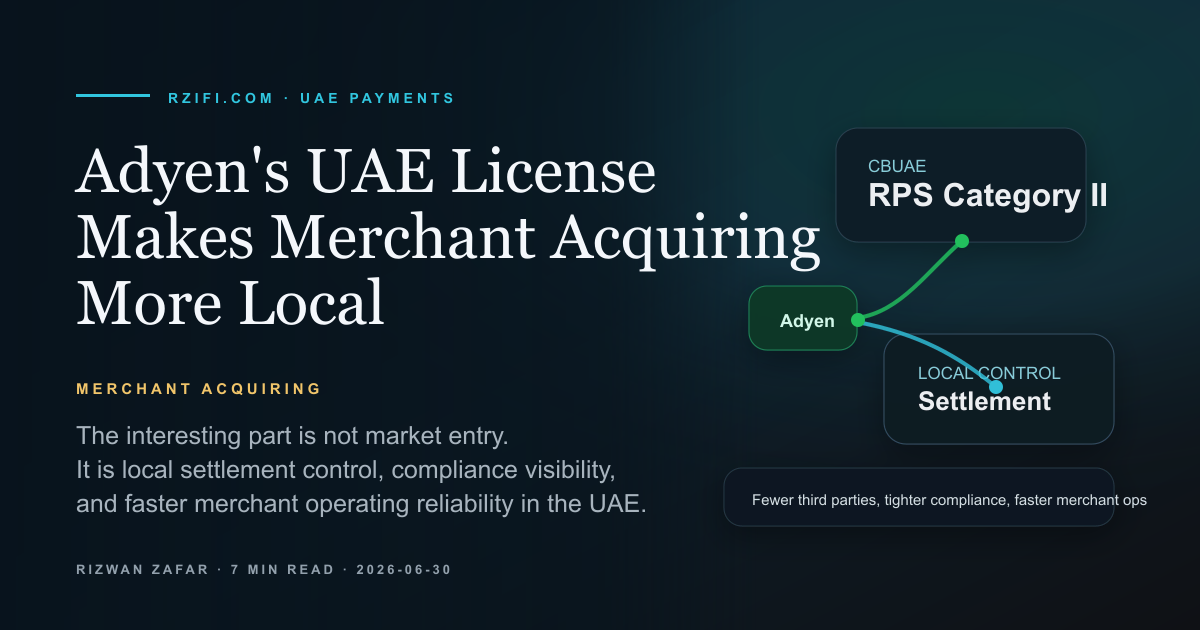
Need help applying this to your business?
Explore practical support for payment operations, product decisions, program delivery and AI automation, grounded in the challenges behind this essay.